

 So here's our final Halloween edition of Out of the Vault for this year, on the fifth Saturday of the month (which is apparently very rare in October, so enjoy it). And appropriately, it's written by the guy who revolutionized horror comics with his reinvention of Swamp Thing at DC Comics in the early 80's.
The comic is Voodoo, a four-issue miniseries published by Image Comics in 1997, written by Alan Moore. And in keeping with our theme, it stars a stripper-witch.
It opens at the bus station in New Orleans, where two men--Attibon and Carrefour--have a civil, seemingly friendly discussion, though it seems apparent that they can't stand each other. And then a woman appears to ask directions, and goes on to offer, totally unprompted, "My name's Priscilla, or you can call me by my stage name if you want. That's Voodoo."
The dialogue is efficient, but clunky. In fact, it may be the clunkiest dialogue Moore's ever written, which says to me that he was phoning this one in (and if you need any evidence that I'm an expert in clunky dialogue and phoning it in, tune in tomorrow).
So Carrefour leaps to his feet, offering to help her find work, and Voodoo explains that she's an exotic dancer (because that stage name thing she said two seconds ago was obviously too subtle). Carrefour takes her to a club called the Midnight Lounge, run by a dude named Christian Charles.
Christian's being accosted by the boyfriend of one of the dancers, who has gone missing. So Christian sends the boyfriend up to his office to find out what happened to Angel, while Voodoo gets up on stage to audition.

Voodoo then meets one of the other dancers, a petite blonde named Purity, and learns that the club used to be a church that was built on the site of former slave shacks built over a burial ground, and holy shit, could you pick a more ominous location? Was the church also perhaps running a puppy mill out back, right next to the illegal abortion clinic/opium den? I mean, geez!
And just in case all that has been too subtle for you to realize the place is evil, we get this in the middle of issue two.
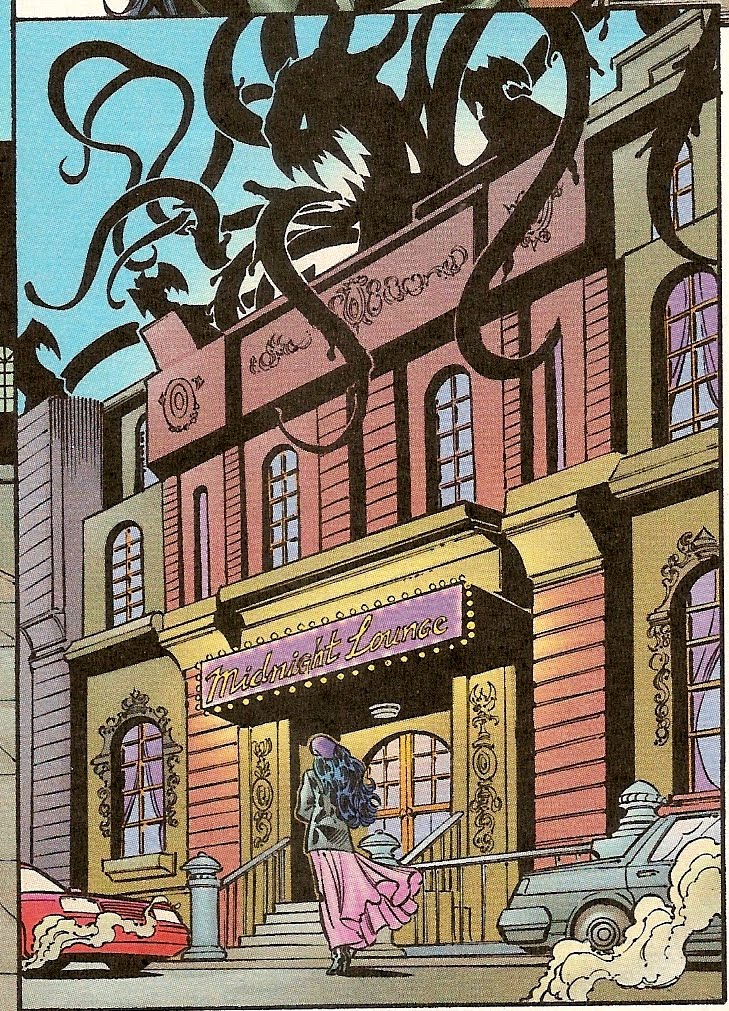
No, Voodoo doesn't realize anything's wrong. She's an idiot.
So Purity takes Voodoo to the boarding house that Christian runs for his girls. Now that Angel has gone missing, maybe Voodoo can crash in her room. Only the cops have found Angel's body and declared her room (covered with arcane symbols) to be a crime scene, so Voodoo's out on the streets again, in the rain, where she runs into Attibon from the bus station.
He takes her to another boarding house, run by a kindly old ex-hooker named Freda. Only it turns out that Attibon and Freda, along with Freda's other roomers--Saturday and Mr. D--are in fact manifestations of the loa Papa Legba, Erzulie, Baron Samedi and Dhamballa. Oh yeah, and of course, it's Christian who's killing his own dancers, as we see dancer Crystal being taken up to his office and locked in a hanging cage (shades of old Aurora Snap-Together model kits!) where her blood is then released to pour down over Christian.
The rest of the book goes pretty much as you'd expect (see "phoning it in" above). It involves Christian's ancestor, a preacher-turned-evil-voodoo-guy who was killed by an angry mob. The mob burned down his church (now the Midnight Lounge) and his home (an old gutted ruin which had been the boarding house where Voodoo stayed just the night before). Now Christian is performing blood sacrifices to gain enough power to bring back the Reverend's spirit, with the help of Carrefour, who is apparently a really super-bad powerful evil spirit when he's not trolling bus stations.
In the process, we get to see Voodoo possessed by Erzulie during her first official act on-stage...

It all leads up to a final confrontation in issue four with Voodoo, Purity, and a police detective facing off against Christian and Carrefour, where we learn this...

What the wha'? Apparently, Voodoo was character from WildC.A.T.S. by Jim Lee and Brandon Choi, an Image title I had never read, and this throwaway line in the final issue is the only acknowledgement of that (or so it seems--looking back through the earlier issues, we do see that Voodoo has an odd outfit that Purity describes as belonging at a Star Trek convention, which prompts Voodoo to mention a gig she used to have). Oh, and the book was printed in Canada, by the way.
 But remember, Voodoo is not a superhero in this comic. She's a stripper-witch, which means she must defeat the villain using the power of sexydance. Seriously. After Christian has finally succeeded in summoning the spirit of Reverend Charles from beyond to possess his body, Erzulie rides Voodoo again, compelling her into a sensual dance which leads the Bad Reverend back to the gutted boarding house, where the scary-ass Damballa (pictured here on the awesome Adam Hughes cover of issue four) blows him up good.
So Voodoo, having been used as the unwitting tool of the loa to defeat the Christians, decides to study voodoo for real. And there are so many levels of muddled and conflicting symbolism in all this that I don't even want to start discussing them, because in the end, once again, Alan Moore + Voodoo = Phoning It In.
So that's that. The Cavalcade of Stripper-Witches is done, and now only one thing remains before Halloween is over and a new year begins (I'll explain that last bit in a couple of days). See you later.


