Showing posts with label novels. Show all posts

Wednesday, November 24, 2010

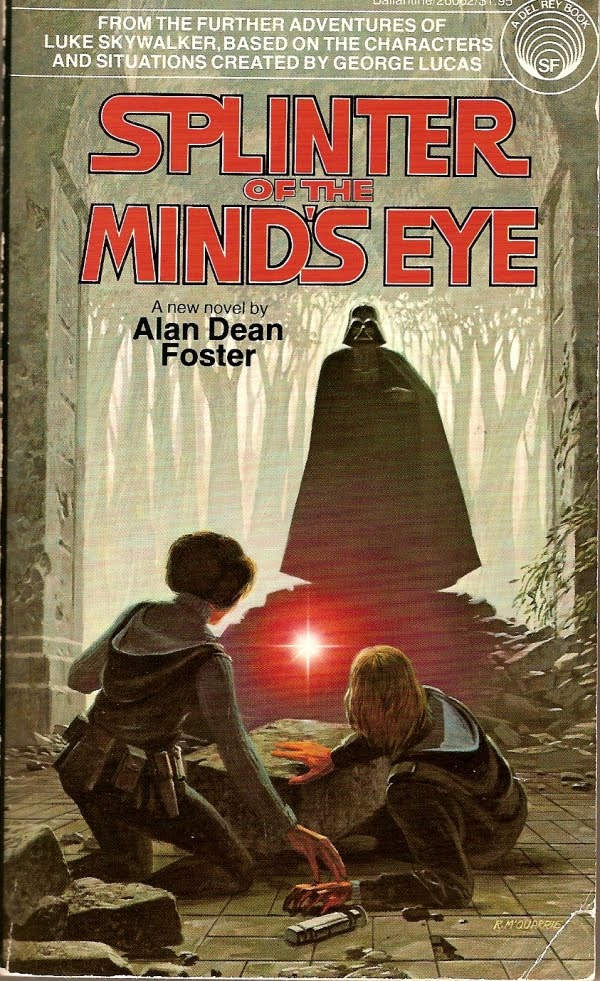
Splinter In My Mind's Eye


So there this gaming blog I sometimes read, and Jeff Rients was talking a while back about how different the Star Wars universe would look if you knew nothing about any of the films past the first one and all the retconning Lucas did. And a few days later, while it was still obviously on his mind, he mentioned Splinter of the Mind's Eye, the Star Wars sequel written by Alan Dean Foster and published in 1978, the year after "Star Wars" came out.

I didn't remember much about the novel except that I didn't much like it, so I reread it last week. And I still don't much like it.

The novel takes place on a planet called Mimban. Luke, Leia and the droids are on their way to a secret rebel meeting on a neighboring planet when Leia's Y-Wing fighter develops an engine malfunction and she sets down on Mimban to effect some quick repairs. Problem is, Mimban is a savage, mostly unexplored planet, and both Leia's ship and Luke's are irreparably damaged in the descent. Even worse, the settlement they thought was a repair station or scientific outpost is actually a secret Imperial mining facility. And the planet holds another secret, a fabled mystic gem called the Kaiburr Crystal that can magnify a person's ability with the Force.

According to Wikipedia, the novel was written as a proposed low-budget sequel should "Star Wars" perform as Lucas apparently expected and tank at the box office. There's even mention that Foster had a space dogfight sequence in the book that Lucas nixed because it would cost too much to film.

In other words, even though books have no effects budget, Foster was apparently obliged to write his to the budget of a TV show. So that, for instance, not only is there no space dogfight (leading Leia's Y-Wing to crash-land because of a coincidental and unidentified engine malfunction), but later scenes in an Imperial jail feature metal bars that disappear and reappear instantly, like most of the special effects on the Lost in Space TV series. Also, since Lucas apparently did not have Harrison Ford signed for a sequel yet, Han Solo does not appear in the book and is only mentioned in passing a couple of times.

There are also clear elements of sexual tension between Luke and Leia, though they don't go anywhere. It appears pretty clear that Lucas had not yet decided to make Leia Luke's sister. This is further supported by the fact that, though Leia fights Vader with Luke's lightsaber, she displays no Force sensitivity at all. The presence of the Kaiburr Crystal, which both Vader and Luke can sense pulling at them, doesn't affect her at all.

Not that I mind the fact that Luke and Leia appear to have a budding romance in this book. That's not my complaint with it at all, nor that it departs from later established canon. After all, I didn't like the book upon first reading, when there was no other canon.

So what didn't I like? A few things. Number one, it didn't really feel like "Star Wars." The scope of the story, limited almost completely to one swampy Dagobah-like planet, felt cramped and small compared to the sweeping interplanetary action of the movie. Also, although the first film built tension by intercutting often between parallel storylines--Luke and Ben trying to get to Alderaan, Vader and Tarkin interrogating Leia to find the rebel base--the book doesn't really do that. Luke and friends flee through the woods, knowing that Imperial troops are in pursuit, but the reader never sees the pursuit. It's kind of boring.

Number two, I didn't like the way Foster used Vader. Foster first sets up the local Captain-Supervisor of the mine as this bad-ass villain, then brings in Vader, but holds him back until the final confrontations. It felt kind of cheap and exploitative to have Vader, such a constant menacing presence in the film, reduced to a cameo walk-on in the sequel just so fans wouldn't feel cheated. If Vader's going to be the bad guy, bring him in early and let him do his thing. If not, then let the other bad guy be the bad guy. As it is, the villainy is spread too thin between two minor figures.

And yes, by "minor figure," I'm speaking of Vader, because he's a chump here. Another big problem I had with the book was the way Foster writes the Force. Taking heed of Kenobi's admonitions to "Let go your conscious self," Foster has Luke using the Force instinctively and unconsciously. Luke blacks out, and when he wakes up, people are telling him, "Wow that was awesome." And despite having only a few hours at most of instruction from Kenobi (on the Millenium Falcon from Tattooine to Alderaan), Luke faces Darth Vader, a Jedi Knight who's been using the Force longer than Luke has been alive, and beats him in a lightsaber duel. At one point. Luke even repels an energy sphere attack by throwing up his arms and closing his eyes like Lois Lane fainting at an imminent flying saucer collision. Please.

I also expected the MacGuffin to come into play in the end. Although I didn't really buy the idea that Luke could beat Vader on his own, I certainly was prepared to see Luke whip Vader's ass with the help of the Kaiburr Crystal, which doesn't even come into play until the fight is over. Halla the crazy woman makes off with Crystal during the fight, and neither Luke nor Vader really seem to care, even though the Crystal is the reason they were all there.

And worst of all, I hated the ending, in which Hin and Kee, the two faithful alien allies who supported Luke throughout the book and were pivotal to his success at several points, were basically forgotten and left to rot once Luke had what he wanted. Luke didn't try to save them with his magical healing crystal, nor did he even consider it. Once Vader was defeated, Luke didn't even offer a moment of regret for the loss of his friends. Instead, the book ends with everyone amused at Threepio's cluelessness. It's very weird and off-kilter.

But it is a fascinating look at how the "Star Wars" universe might have developed. Luke going to a swamp planet to develop his Force abilities is clearly a foreshadowing of Dagobah, with crazy Halla and her magic Force crystal standing in for Yoda. And the big battle between the Imperial soldiers and the native alien Coway tribe clearly scratches the same itch for Lucas that the Ewok battle in "Return of the Jedi" and the Gungan-Droid battle in "The Phantom Menace" did, with primitives pitting themselves against the most advanced technology and prevailing.

Friday, September 24, 2010

HGH Update

It's Friday, which means there's another chapter of Hero Go Home live here.

Also, in case you haven't been following along, here's what you've missed so far:

Chapter 1: Skintight blue jeans and hovering don't mix.

Chapter 2: It helps if both ends of a conversation know the code. Also, there's a mission from God.

Chapter 3: Singing purple dinosaurs might still try to eat you.

Chapter 4: There's really no way to prove someone doesn't eat his own poop.

Chapter 5: Being a mascot isn't so bad, if you can blow stuff up.

Chapter 6: Stench and misery are part of the Digger mystique. Also, Yodaville.

Chapter 7: Secret identities suck almost as much as too much exposition. Didn't you know?

Chapter 8: Fighting supervillains isn't football or checkers or tic-tac-toe. Well, maybe Australian rules. What are the Australian rules for tic-tac-toe?

ETA: There's something else that's subtly different, as well, though if you haven't visited before, you won't notice. But you'll notice next week...

Sunday, August 01, 2010

It's Alive!


Finally!

Friday, July 30, 2010

Workout Supplements and Writing

Every now and again, I get on a workout kick. I just get tired of being out of shape and embark on about 90 days of hard workouts to get myself built back up again, after which I let things slide for a while (I would be on one now, if I had a job that allowed me to afford air conditioning).

What frustrated my wife about the kicks I would get on, though, was that I would invariably spend 50 bucks or more on protein powders and other supplements that she figured I didn't need.

And she was right. You can find plenty of articles attesting to the facts that...

  • Supplement effects are overrated
  • They can't compensate for a bad diet
  • Their effect is likely to be minimal unless you're participating in very hard workouts
  • There is no guarantee that the research behind them is solid or of the purity of their ingredients

I know these things. And yet, every time I enter a workout cycle, I go out and buy the stuff. Why? And what does this have to do with writing?

The reason why reveals perhaps my own weakness, and yet it's a weakness I'm at least aware I have and know how to exploit for my own benefit (at least short-term). The new object in my life gives me a talisman, a physical object that serves as a reminder of my goal and what I need to do to achieve that goal. And because it's new, I get the added motivation of learning something new and figuring out how to make it work for me. I get to play, and that helps keep me motivated.

I do that with books as well. I seem to approach every new book differently. Blue Falcon (as well as some of my earlier screenplays) was written mostly in longhand at bars, to the point where it got hard for me to write any other way, with a very basic outline outline written in Word. Angel Baby, aborted after 100 pages, was written in an office I rented. I think I also tried using a product called yWriter during this time, but didn't get very far with it.

Hero Go Home was outlined on note cards and mostly written at the same office, partly during Nanowrimo;. For the second draft, I noted the story's different locations on Google Earth. For a proposed sequel to Hero Go Home (which was to become Digger's Big Con, the aborted webcomic story that I need to finish someday) I made a lot of brainstorming notes on a website called KayudaMaps, which subsequently shut down, losing all the notes in the process.

Death Wave was outlined with a product called Anthemion Writer's Cafe. It was demo software, though, so I wasn't able to use its full capabilities.

So here we are on a third (and I hope, final) draft of Hero Go Home, and what have I done? Besides the chance to play with the layout of my website, I've downloaded two products to help me do what I have never done well before--outline the story. There's a product called Freemind, which is mind-mapping software that I'm using like the old KayudaMaps, only I don't have to worry about the website shutting down and dumping my data. And I'm using yWriter 5 to put meat on the bones.

I didn't like Freemind at first, but now I'm starting to get the hang of it and it's actually helping me figure out the flow of my story. It works with objects called nodes, which is a piece of text. Each node can have siblings and children. So I make a node for a scene, then sub-nodes for each beat of the scene, and if I have a specific piece of information I need to fit in, or if I have an idea for a great line of dialogue I want to have there, I can give it a sub-sub-node, and so on.

And each family of nodes is collapsible, so I can look at the overall flow of a story at a glance, but if I want more detail on a given scene (say, the one I'm writing at the moment, or one I want to foreshadow, or one I want to flash back to), I just open that node and the tree of sub-nodes under it pops open.

yWriter also, I didn't much like the last time I tried to use it. It was an earlier version, though, and it intimidated me with all the fields of information it wanted about characters and such. You build the book in chapters and scenes, and there are database-style fields for you to keep track of characters and locations and such, with space for detailed descriptions. You can even run reports that tell you how many scenes each character is in, or show it visually as a storyboard with a card for each scene on a timeline. The important thing is, I'm more comfortable with leaving as many fields blank as I want, only adding stuff as I go along and discover new things about the characters.

For some reason, I thought I was doing it wrong when I didn't know my characters inside and out when I started to write. But all of the standard methods of filling in backstory and doing character work ahead of time just make my eyes glaze over. It seemed as if I was doing a lot of extra work that I might never use and had little to do with the story I wanted to tell.

And while I am more comfortable now with doing character prep than I was, I am also learning to accept that I will never know my characters perfectly before I start writing. At some point in the writing process, I stop telling them what they're like, and they start telling me instead. It sounds like an artsy-fartsy cop-out, but it's true. Lisa--one of the main characters in Death Wave--was supposed to be a throwaway background character, but emerged to become a driving force in the story.

So will these products be the magic bullets that somehow fix what was wrong with the story in previous drafts? Doubtful. There's no guarantee that I'll have the patience to use them to their full capabilities, or that I will be able to somehow unlock new mental abilities thanks to their help.

But right now, they're helping me focus what were previously really unfocused efforts at revising the plotline, and I'm encouraged at the results. To be painfully honest here, a few days ago, I was really excited with the look of the new website, but very scared that I would have no idea where to go with the story once I got past the first couple of chapters that had already been written. I had serious flopsweat going, and I don't now.

I mean, I still don't know if the book will find an audience, but I'm much more confident that there will at least be a book. And a better book than before.

Monday, June 28, 2010

Pieces of a Larger Puzzle

So I wrote recently about the idea of publishing Death Wave myself, and I tied it into the idea of finally going out and making this writing stuff that I do actually earn me a living.

Two big problems with that:

Number one, it's scary.

And number two, I've not been very good at it so far.

I mean, the DIY ethos sounds great when you're discussing it around beers late at night, but it's not as if I haven't tried it before. Blue Falcon went nowhere. Hero Go Home, the webcomic, fizzled (partly because I was still learning about pacing, partly because I had other things taking up a lot of my time, but also largely because I enjoy writing much more than drawing, and the art was a shit-ton of work for very mediocre result). Even this blog, which was basically started as an attempt to let folks get to know me and maybe build a following, is basically read by my friends and no one else (not counting the dozens of folks who visit once while searching for pics of the Barbi Twins or Tig Ol' Bitties).

But here I am with time on my hands and a desire to do more, go farther, than I have before. So I'm working on a few projects. I haven't figured out which one I want to lead with yet, aside from one small announcement I'll be making very soon.

One is publishing Death Wave. It's more or less ready to go right now. It could use an editing pass, and needs some other work, but most of the heavy lifting has already been done.

Another is perhaps publishing an anthology of Digger Universe stories. I don't have a lot of those so far. There are basically four that have been published (three starring Digger and one starring Digger's former teammate AcroCop), plus another that was started but never finished, another that has been basically plotted but not written, and another unrelated story that also features supers and could easily fit into the universe with a couple of tweaks. So that's seven, which is not really enough for a proper anthology, but could serve as a chapbook or something that could be the seed for future development. But since all the writing hasn't really been done yet, it's not as "shovel-ready" as Death Wave is.

Another possibility is finally doing another draft of Hero Go Home. I still take out the idea and mess with it, trying to find a way to make it work. I really want to make it work, although two bad drafts has pretty much scared me away from it. But if there was interest in the Digger anthology, I could certainly see myself writing this up as a follow-up. If there was interest in that, I might even figure out a way to finish Digger's Big Con, the storyline I barely started in the webcomic.

Also still rattling around in my brain is the new book I want to write, the Twenties-era Johnny Dollar meets Cthulhuzilla story. And at the same time, I'm playing around with notes for a role-playing setting that I might have finished enough and be brave enough to present to friends by the time our current Atlantis game starts to wrap up in a year or so. I probably won't make any money from that, but there are a lot of indie publishers with PDF's for sale on DriveThru RPG. Somebody must be making some money. Maybe after I've run it a while, it will be something I feel confident enough to sell.

Will any of this pay my bills and make me a living? Seems doubtful. Nothing here looks like a Penny Arcade/Schlock Mercenary caliber idea. Then again, who knew that those would take off the way they did? I did have an idea once that struck me as a possible hit, but I had neither the money, nor really the desire, to pursue it to its conclusion.

The point is, no matter what's going on with my current job situation, I feel as if I need to start putting more stuff out there. I know some people will buy it. I know my work is worth paying for, because I've been paid for it by professional markets. Now I need to find the right way to connect with the right audience, and find the confidence and enthusiasm to start producing the kind of work I was producing five years ago. And hope enough people will pay for it to make it worth the effort.

Corinne Bohrer, give me strength.


Monday, June 21, 2010

More Logo Goofing Around

Looking at the logo I did, it occurred to me that it wasn't so much the shape of the font that made it seem so cartoony, but just the bright flat colors. So I toyed with muting the colors a bit and adding some grunge texture. It looks more interesting now.


I'm putting together a rough concept of a proposed cover that may take a while to finish, but right now, I've got some free time on my hands.

Monday, June 07, 2010

Master of Men


I mentioned earlier that I'd picked up a Spider book by Norvell Page. I just finished reading the three-novel volume (Satan's Murder Machines, Death Reign of the Vampire King, and The Octopus) and... wow.

On one level, they're not great books. I mean, there's a reason "pulp" was long synonymous with "trash." A typical passage, from Satan's Murder Machines:

Jackson cried out softly as the car whipped into the side street that flanked Wentworth's Fifth Avenue apartment house, and Wentworth saw the reason why. A long black limousine was just sliding past the street's end, slowing to a halt before the main door--and that limousine had blood-red headlights! It was the car of Stanley Kirkpatrick!

You see the dilemma here. On the one hand, exclamation! points! everywhere! There's barely serviceable prose and clunky dialogue in great abundance. Like many pulp authors, Page often finds himself stretching for adjectives and adverbs and not... quite... reaching the right one.

But on the other hand, there's a limousine with blood-red headlights! That deserves an exclamation point. And that's not even the bad guy. That's the Police Commissioner, the Spider's own personal J. Jonah Jameson, a regular member of the supporting cast.

The novel itself is full of thrill-a-minute action on a scale I'd never encountered before Page. I've sadly never read a Shadow novel, but I'd read a few Doc Savage ones in my youth, suckered in by those awesome James Bama covers in the 70's. But though people talk about Doc Savage's action-packed adventures, they're positively dull next to the Spider's tales.

In the first scene of Satan's Death Blast, the Spider kills a roomful of men, but is shot and wounded himself by a mysterious assailant just before the police show up outside and the Spider is forced to flee. Likewise in Satan's Murder Machines (and no, the recurrence of "Satan" in the titles does not mean they featured the same villain--either Page or his editor just liked using "Satan" in the title to denote ultimate evil), the first scene has the Spider attempting to kidnap a security guard for questioning, only to be interrupted by a cop and a robot, and during the fight, he receives a radio message that his secret identity has been framed for burglary. In both books, the Spider runs desperately from confrontation to confrontation in near real-time, avoiding the police while hunting the villains. Neither he nor the reader have a chance to catch their breath until about 2/3 of the way through the book, to set up the final battle.

Compare this to Doc Savage, which would usually start with some random person in trouble, who then seeks out Doc Savage. In chapter 2 or 3, we are introduced to Doc and his assistants, and by chapter 4 or 5, Doc gets into the actual investigation, which proceeds with much banter between his assistants and the Guest of the Week. The Spider starts at Chapter 5, kills off the Guest Stars before they have a chance to make a joke, and runs desperately to catch up the rest of the way. This is what Sargon means by "relentless."

In a way, you could say that the Spider was Marvel to Doc Savage's DC. Which is more apt than you may think, considering that Stan Lee has said that the Spider partially inspired the creation of Spider-man. Now that could be a big load of Lee bushwa, but then again, it's not just the name that ties Spider-man to the pulp hero. As I mentioned above, the Spider spends much time running from the police, a problem Spider-man shared for much of his career. And the overwrought emotions of the Spider, occasionally agonizing over the fact that his crusade against crime has stolen his personal life and that of his fiancee, bears much more resemblance to Marvel's 60's heroes than the staid, cerebral (Doc Savage-like) science detectives of the DC stable.

So it came as a strange shock when, in the first chapter of Satan's Murder Machines (which, remember, I bought just after seeing "Iron Man 2"), a fleeing villain screams, "The Iron Man! God save me! The Iron Man!"

Hey, maybe Smilin' Stan really did read the Spider.

Then I get into the second book in the volume, Death Reign of the Vampire King (love the titles), and Chapter One is titled "The Bat-Man." A quick check of the original publication date, and good God, it came out in 1935, a few years before the first Batman story (although as any true fan knows, in his first story, he was known as The Bat-Man). So did Bob Kane also read the Spider?

Hard to say. Batman writer Bill Finger read pulps. Batman was supposedly inspired by Johnston McCulley's Bat, as well as McCulley's Zorro, and we know Finger adapted a Shadow novel into the first Batman story. Could he and/or Bob Kane have read this one as well and unconsciously swiped the name? Who knows? But it's fun to speculate.

Then I read the third novel, a non-Spider story titled The Octopus, expecting a let-down, but holy shit. The main character is a nondescript rich dude named Jeffrey Fairchild, who for some reason decided he could do more good for society as a kindly old doctor named Dr. Skull (yes, in this world, patients willingly and even eagerly seek out a doctor named Skull), and in his non-doctoring time, Fairchild hunts down criminals as the Skull Killer (and no, with one exception, nobody ever remarks on the similarity between the two names or imagines any relationship between the two). That's right, "Skull Killer" is the good guy. And you thought the 90's were grim'n'gritty.

The bad guy is the Octopus. Hmmm. No real comic book connection there. Oh wait... he's a doctor. Okay, maybe he's not actually a doctor, because it's never explained exactly who he is, but his entire scheme does revolve around an insanely outlandish plan to turn people into vampiric creatures with salt-water blood via ultraviolet radiation in order to scare people into thinking there's an epidemic and extort health insurance money from them. That's right. It's a big health insurance scam. Who said pulps aren't relevant to the modern world?

Anyway, the entire novel is a crazed running battle between the man with two secret identities both named Skull and a tentacled, telepathic monster running a health scam, featuring vampires with glowing purple eyes, and it just misses being the greatest book ever by having a disappointing climax that never gives even a hint of who the villain really is or where he came from, and a side plot involving the hero's sullen kid brother that never goes anywhere (I'm assuming this would have been a recurring feature of the series if The Octopus magazine had lasted for more than one issue).

Anyway, still noodling the idea of self-pubbing Death Wave and chipping away at the plot of the new novel, but no major progress to report.

Friday, June 04, 2010

Impatience

Impatience has led me to lots of bad decisions. I understand this, and yet, it doesn't keep me from doing it again and again. Because for me, the opposite of impatience is dithering, refusing to pursue something because I'm afraid or feel as if I don't know enough.

Example--impatience: Burned out at my job at Newport Television, I quit without having another job lined up. I actually wanted to try owning my own business, but by the time I had to leave Newport, I hadn't found exactly the right thing. So I jumped into The Biggest Mistake of My Life, which is still weighing down on me today, almost a year after it blew up in my face.

Example--dithering: I dropped out of college in 1984, and have intended ever since to finish my degree. But although I've looked into it several times, and even went back to school for a while right after getting out of the Army, I still haven't finished my Bachelor's, mainly because I can't commit to a major. Pathetic.

But there is one decision I made out of impatience that I'm still not sure whether it was a mistake or not: Blue Falcon. The link describes the pros and cons of that situation pretty well, but it boils down to the fact that I'm embarrassed by the book and by the stigma of the vanity press, even as I'm proud of parts of the book and learned many valuable lessons about writing and publishing through the experience.

The experiences I've gone through since, having joined a writers group and published fiction professionally, make me think I jumped the gun by going to iUniverse. Then again, a part of me thinks that I would have been unable to move on and have those other experiences if I had not made the plunge and gotten Blue Falcon out of my system.

Why am I bringing this up again?

Because of a chance Facebook thread of an author I've talked to on-line here and there, a very talented fellow named Steven Savile. It was regarding a decision by another author to release his books through createspace.com, Amazon's self-publishing venture. And the tone was somewhat admiring of the guy for taking control of his own fate, because midlist authors are stuck in a terrible place, professionally.

And suddenly it seemed to me as if the idea of POD publishing had suddenly become not as stigmatizing as it once was. And here I am with a finished novel, Death Wave, that I think is pretty good, but is a hard sell to publishers because it's so short. Should I try this again?

On the one hand, I haven't really explored my options with traditional publishers. I've submitted to one publisher, Hard Case Crime, and been rejected. I've checked out a few other publishers, and almost without exception, they ask for word counts substantially higher than Death Wave's. I've queried a few agents, but have gotten no bites so far.

But I could spend years pitching Death Wave and not have it go anywhere, or maybe place it with some small publisher who gives it a crappy cover and dumps out a few copies at conventions here and there.

Or I could give this DIY thing another try. Design my own cover, maybe commission a few interior illustrations to give it that truly pulpy feel. Maybe add in a special bonus short story to round out the volume, fatten it up a bit to give more value for the money. Use the lessons I learned from Blue Falcon to put together an even better product this time, and use what I've learned about social media and web advertising to reach a bigger audience. Redesign herogohome.com and use it to add value to Death Wave (and maybe also to build an audience for a Digger anthology or future books).

It may thud as loudly as Blue Falcon did. But look at a guy like Jonathan Coulton, who decided to blow off the rat race and grab destiny with both hands. It paid off for him. Then again, he was ready. He had the skills and he was able to connect with a big enough audience to make it work. And he appears to be the big exception to the rule. There are a lot of people out there trying to do the same thing I would be trying to do, and I would need somehow to get my message to those people who would be interested in what I'm selling at a time when they have the cash and motivation to buy.

The question is, can I? And whether I can or not, is it worth the risk?

Or am I just being too impatient again?

Wednesday, May 26, 2010

Getting Bigger

So when I was originally brainstorming the new book, I had an idea that I immediately dismissed as too over the top. A couple of weeks later, I decided to go ahead and make that the climax.

Then I saw "Iron Man 2," using a free pass my mom gave me last year that I had never gotten around to using, and afterward, I dropped by Barnes and Noble, where I picked up a compilation of Spider pulp novels reprinted by Baen under the title, Robot Titans of Gotham (with a cover by Steranko, woot!). On the discount rack for five bucks!

Just looking at the cover, I immediately felt that my too big, over-the-top novel climax was now too small. I've only read a couple of Spider novels by Norvell Page, lent to me by Sargon, and his words echo in my brain. That the novels are relentless. They never let up. I don't know if Satan's Murder Machines lives up to that Steranko cover, but that's what I want my book to live up to. And it occurred to me that it would be a cool trick if I could pull it off, to make what seems like the predictable climax happen in the second act, so that people can still be surprised when the story spins into unexpected territory.

I don't know if I can come up with an idea big enough, but that's what I'm shooting for. To have a first act where people say, "No way he would go that far," a second act where they say, "Holy shit, he did go that far, but look how many pages are left! WTF?" and a third act where all they can say is, "Dude!"

Corinne Bohrer doubts I can pull it off.


But Caroline Munro believes in me.


Corinne Bohrer can't believe I'm bringing in another imaginary kibitzer.

Tuesday, May 18, 2010

Taking Shape

So what did I do with myself yesterday, having given myself permission to lay off the regular feature updates for a while? Interestingly enough, I did a little work on my book idea.

There's an interesting tension between forced productivity and paralysis. When I was working at the Daily Oklahoman in the 80's, I wrote three or four screenplays and pieces of a couple of novels. The discipline of having to write at work on demand gave me the ability to do so on my off hours as well. In the years after I left the paper, though, I pretty much stopped writing for several years.

I picked back up in 1992, challenging myself to write every day, which resulted in a screenplay. Then I enlisted and didn't write as much, though I did write one incomplete novel during the next five years. Leaving the service with a book idea and a year's worth of research done during my second tour in Korea, I wrote my first finished novel, but didn't write anything else during a five-year period.

When I was unemployed last year, I took to the regular features on my blog as a way to keep myself disciplined, and eventually made myself write a novel as well, while still maintaining those regular features.

But since I've started working again, I find that all my free time has been taken up with thoughts of the regular features whenever I sit down to work. I keep telling myself I'll work on the book, but I've got to get the weekly features out of the way first, and I've had less and less mental energy to do both.

So now I'm turning my energy toward the novel instead of scanning comics and doing screencaps of movies. Which is not to say I've done a whole lot of actual work. Most of what I'm doing right now is technically called "stalling," which is to say I'm turning ideas over in my head again and again, trying to find the approach I want to take. Romancing the stone, so to speak.

I spoke before about "negatives," giving myself a list of things I didn't want to do. The problem with negatives is that, if you don't have a bigger and stronger list of positives--things you want to write about, qualities you want the finished product to have--then basically what you've done is talk yourself out of writing anything. Which is where I was until yesterday.

So I asked myself in the simplest terms, what do I want the finished product to look like? What book do I want to write?

And the answer I got was, "Johnny Dollar meets Godzilla/Cthulhu, in the style of 'Big Trouble in Little China.'" Which means what? More or less, action-comedy with trappings of mystery and supernatural horror in a period setting. I paced around for a while today and sketched up an idea map for the story. Not a plot outline, per se, but just an idea of all the factions at play and the overall scheme.

Now I need specifics, especially characters. Characters have always been a weak spot for me, but Death Wave showed just how much good character work can pay off in the writing. I had a really firm grasp on my main characters for that one, and they surprised me a couple of times.

So my next steps: develop my main characters, and take the plot from vague overall notion to a list of specific events and scenes.

Tuesday, April 27, 2010

Negatives

As I said a couple of days ago, I have a new novel idea I've been toying with. And it strikes me that one element of my personal creative process seems to be one that I don't see remarked upon very much by other writers.

That element is this: although the initial idea arises as something positive--the type of story I very much want to read--the development of that initial idea is governed at least as much by negatives--the kinds of things I want to avoid in telling the story.

For instance, the current project is another period piece somewhat like Death Wave, but a more fantastic, science-fictional story with greater scope and maybe a Cthulhu-style horror tinge to it as well. And as I was developing the idea, I became intrigued by the idea of setting it in Tulsa.

But from there on, I started defining it by negatives: I don't want it to be the typical story set in the city where the author lives just cause the author wants to tell everybody how awesome his home town is, so I'm thinking of making Tulsa alien and strange and downright scary. I don't want the book to follow the basic Cthulhu storyline, with doomed hero fighting a losing struggle against an immensely powerful entity that cannot be defeated, only delayed for a time. I don't want the villain to be the basic stock villain everybody uses: a greedy wealthy industrialist, for example, or a secret government conspiracy plotting to destroy freedom for the greater good, or God help me, Nazis.

A certain part of me wants to think that every writer does this--defines the story before writing it as this, but not that, circumscribes it, places limits on it, assigns it a certain format like a sonnet or a haiku--but I either take it to an extreme or else do it poorly, because I find myself writing things that I like but have no confidence in. In my quest to avoid cliche, I also manage to avoid audience identification, leaving my story filled with characters and events which are unlovable and unbelievable, but are at least not cliches, thank God.

I want to think I'm getting better at this. At least, I hope I am, because I really need for this next book to be The One, if you know what I mean. I think I've got the technical ability. Now I've just got to hit on The Story and The Character that will click with agent, editor and audience. No easy feat, and as the years press down on me, I find myself believing less and less that I will ever manage it.

But I keep trying, thinking every time, "This is The One." I hope I'm right this time, but there's a lot of words between me and that goal.


Tuesday, March 02, 2010

Earning Out

Fourteen years ago, I headed back to Korea for my second tour and my last year in the Army. And during that final year, I researched and read, gathered materials and articles here and there and assembled notes for a novel about a modern-day war in Korea.

A year later, I got out of the Army, came home, went through the piles of research I had assembled, and began writing said book, titled Blue Falcon. Three years later, the book was finished and I began searching for an agent.

I had some nibbles, including a full manuscript requested by a pretty prominent New York agency. But in the end, I got nowhere with it. I spent about three years trying to sell it, and every time I tried to work on something else, my mind kept getting seized back to Blue Falcon and Korea.

Finally, I decided enough was enough. In late 2003, I scraped together some money from various sources, including selling plasma, and published the book through iUniverse.

In some ways, it was a stupid decision, and in other ways, it was the best thing I could have done. The stupid: iUniverse is a vanity press, and despite its best efforts has never been able to shake that reputation. So I ended up with several copies of a book no one wanted to buy, other than my mother and a few friends.

The best: deciding to publish forced me to think like an editor and pare the manuscript of tons of fat. And the comments I got when I submitted it to the iUniverse Editor's Choice program were more specific and insightful than the comments I had gotten from either the big New York agent or the Penguin Putnam editor who read it. By the time I finished revising the manuscript for publication, the book was miles better than it had been before.

Even better: getting the book published, and holding it in my hands between two covers, allowed me to finally put the book to rest in my mind and move on. Without iUniverse to help me get Blue Falcon out of my system, there would have been no Digger, no Death Wave and no Whatever Comes Next.

But I have to say that putting Blue Falcon between two covers also allowed me to get the distance to see its many flaws, to the point where I'm more embarrassed every time I think about it. Nowadays, I mainly try not to think about it at all.

So it was a weird surprise tonight to go over to my wife's house to see my daughter and find a letter from iUniverse. Even stranger to open it up and realize it was a ROYALTY CHECK!

For, uh, $3.78.

But still, that's $3.78 more than I ever expected to get out of it.

Sunday, January 17, 2010

Wow, That Was Fast

Well, I sent off the novel on Friday, and on Saturday, I got an email from Charles Ardai, the editor/publisher of Hard Case Crime. And it was the nicest rejection you could imagine, but it was still a rejection.

Which leaves me in a bit of a tough spot, because it was so completely designed for them, including the length. 53,000 words is a really short novel, perfect for them, but a hard sell anywhere else. And I can't see trying to pad it out to 70-80,000 words. That's half-again what I've written already, and the story just won't support that.

And then there's the genre problem, which was part of what made Hard Case say no. Death Wave is a crime novel, a noir revenge thriller, but it has science fiction overtones and elements. Albert Einstein has an early cameo, and there's a MacGuffin which is a notebook by Philo Farnsworth, which gives it an alternate history flavor as well. And it's funny, at least in the early chapters, so it's hard to tell right at the start what kind of story it's going to be.

I tried to telegraph that ahead of time with my opening sentence, which starts with the words, "The day I baked Hyman Mankiewicz...," which at least lets you know there's death in the works (and death in some abundance, I should say), but I can see how that might throw some people off.

I suppose I could rewrite the opening to make it darker, and cut down on the speculative elements. But I wanted the book to have its own distinct flavor, and those things give it that distinctiveness.

So I'm getting ready to put together a submission for Tor, and I'll try to keep my eyes open for other possible publishers. I would really like to get onto Codex again and see if anyone there has a suggestion, but I kind of burned my bridges with them with my post-election blow-up.

Which sucks, because Codex was a great group, and I really liked the people. But I can't see going back there again.

Oh well. Just have to keep trying.

Friday, January 15, 2010

Fine-the-EFF-ally

Typed my last revision on Death Wave this afternoon. And then did probably a profoundly stupid thing--rather than read it through again to see if it's any better, or to just to catch any new or old typos, I saved the file and sent it to Hard Case Crime straightaway.

Because I've been letting my fear and lack of confidence keep me frozen into inactivity for too long. And I needed to break out of that and not give myself another excuse to delay. I needed to get that book out the door and out of my system so I can move on to other things.

And now I have.


Corinne Bohrer is cautiously optimistic.

Friday, October 09, 2009

Distractions

It has been a unique feeling for me, in the days since I finished the first draft, for me to have no interest in the manuscript whatsoever. The books I've finished before, I was on such a high after finishing that I couldn't wait to go back and start reading from the beginning, experience the whole thing in one big panorama.

I haven't done that this time. I actually started divorcing myself from the manuscript even before I finished it. After 32 or 33 days, I was sick of pushing myself, especially at the end when I could feel the failure pressing in on me. So I did the GIMP-shop that serves as my new profile photo. Then I made myself finish the manuscript, and instead of rereading it from the beginning as I formerly have, I didn't even think about it.

Instead, I started up another GIMP project. It was originally supposed to be a quick and dirty test of a concept for photoshopping a picture of a person into a superhero (and yes, I just used "photoshop" as a generic verb--if Adobe wants to sue me, they are welcome to learn just how broke I am). No, the character is not anyone you would have heard of. I just made her up as I went along, obviously ripping off the outfit from Mr. Incredible/the Flash, and going on from there.


As you can see, it eventually grew into something bigger, and is now the wallpaper on my desktop (this is a scaled-down version for web display).It's not perfect, but it's better than I expected it to turn out. If I were trying to sell this (I can't, because I have no rights to the model image I used), I'd spend a lot more time on details like making the boots and belt and bracers more realistic and improving the graphics spelling out Neutrina's name down the side.

On the other hand, the logo symbol I tossed off for the character looks pretty good, and the background, which was assembled as an afterthought, isn't horrible either. I learned some valuable lessons putting this together, and added some techniques to my toolbox, like layer modes. If I had the patience and inclination to do this all the time, I almost start to think I could make a living at it. Of course, you could say the same thing about writing, probably. Alas, I don't have the patience or inclination to become good enough at any one thing to make a living at it.

That would appear to be my doom.

Tuesday, October 06, 2009

Pounding It Out, Day 36

Success!

Finally.

53,000 words, give or take. It sucks, but it's done.

And maybe, once I've gotten some distance from it, I'll find out it doesn't suck as much as I think it does right now. Maybe it'll be worth fixing up and submitting to Hard Case Crime. That was my ultimate goal when I started this, and until I'm sure the book is hopeless, it's still my goal.

I'm still broke as hell, but I have some cigars left from back when I was solvent. I think I'll light one up tonight after I get back from seeing my daughter. I may even splurge on a cheap little champagne split or something. I haven't had anything worth celebrating in my life for a long time, so I want to make the most of this moment.

Corinne Bohrer wants to congratulate me in a very special way. If only.

Sunday, October 04, 2009

Pounding It Out, Day 34

Well, I passed the 50,000 word mark yesterday, but the draft's not done yet. I'm in the climactic scene, though, so it should only be a day or two now. The big problem that has been slowing me down: I did a little research that convinced me my final scene was completely improbable, location-wise. So I'm completely replotting it on the fly, which is going very slowly.

My other big problem: I had decided to write a book with a main character who was a remorseless killing machine. However, I find I'm having trouble making him be that. And I'm having second thoughts about the ending I'm heading toward. I don't know if it will be satisfying, to readers or to me. And as often happens in my writing, I've engaged in some self-sabotage, writing scenes that are disturbing. Which is weird, because I know lots of people who write similar stuff that's worse and seem to have great success, yet when I try it, it always seems to misfire.

But the questions will only last at most for a couple more thousand words and then I'll be done. For the nonce.

Thursday, October 01, 2009

Pounding It Out, Day 31

Failure!

And yet not.

I did not make my arbitrary deadline of 30 days. But I did not end up far off either. At midnight, I was at 47,500 and heading into the final confrontation. So on the one hand, yes, I failed. But on the other hand, I am very close and almost assured of finishing a first draft very soon. The first half drags, and the second half lurches and the climax is probably going to be entirely too short and vague, but it will be something I can build on and fix.

So "encouraging failure," like "good rejection," is not something to be sneezed at in this business.

Sunday, September 27, 2009

Pounding It Out, Day 27

I finally hit the wall, and in the weirdest possible place. I'm nearly to the end--only about 8,000 words to go--and instead of picking up momentum, I'm stopped dead. I'm not sure how to get from where I am to the climax.

It feels like I have overcomplicated what was a very simple storyline. In trying to set up my denouement, I've blocked myself from the climax preceding it. So I need to either work out a way to push through this quickly, or else scrap the last thousand or so words and take a different, simpler path.

Or do what I usually do and put the manuscript down for six months or so, then see if I feel like picking it up again. Crap.

Corinne Bohrer senses disaster.

Friday, September 25, 2009

Pounding It Out, Day 25

Not a lot to add today, since I just updated progress yesterday. I'm still grinding it out, staying pretty close to pace. Past the 40,000 word mark now.

The one big thing is, back on day 8, I had mentioned a twist I'd come up with for the ending that I was debating whether to use or not. Today, I started setting up the groundwork for that twist in the text (in one sense, you could say that I've been setting up the groundwork for the entire book, but it gets sort of specific now). In fact, what I'm doing now may help me bring direction to the entire third act and make that final denouement seem less like a twist ending and more like something inevitable (although still ironic and maybe even funny, which, given what has happened in the last 90 pages I've written, might seem inappropriate).

We'll see what happens. If nothing else, I'll have something unusual to show people at parties.