Showing posts with label Batman. Show all posts

Monday, April 26, 2010

Movie Monday - Batman: Mask of the Phantasm, 1993


Yeah, I know. More Batman.

Actually, while I was in the thick of the Batman series a few weeks ago, Sargon the Terrible mentioned this one other Batman theatrical feature I had skipped. I blew it off at the time because number one, I only had this movie on VHS, and number two, it's part of the vast DC/Warner animated universe that I couldn't do any justice to in a single post, and number three, well, I was already up to my neck in Batman and didn't want to get any deeper in the weeds.

But Sargon had the DVD, and I've had a few weeks away from Batman movies (though not from Batman, if you've been reading Out of the Vault on Saturdays) , so here goes--"Batman:Mask of the Phantasm."

The movie was an outgrowth of the Batman animated series produced by Bruce Timm and Eric Radomski. The series was immediately embraced by fans because of its darker, more mature feel, truer to the character than either the sunny Hanna-Barbera Super Friends-style Batman cartoons of earlier generations or Burton's dramatic, but odd interpretations. The animated Batman had all of moodiness of Burton's films without the weirdness. Timm and Radomski's Batman was a modern-day noir hero, Sam Spade with a cape.

The movie opens with a typical shot of Gotham City. One of the innovations used to enhance the moody feel of the series was to airbrush the backgrounds on black paper, giving everything a dark, gritty feel.


Some crooks are meeting to discuss the distribution of counterfeit bills, when Batman swoops in to break up the meeting.


You can see that though the animated series took a lot of inspiration from Burton's Batman, they still stuck with the classic comic book version of the tights, rather than the movie's body armor approach to the costume. There's a fight and gangster Chuckie Sol flees. But in the parking garage, Sol runs into this mysterious apparition.


And here you see the real secret to the success of Timm and Radomski. They were thieves. They stole shamelessly, from everywhere. For instance, compare the Phantasm above with the Reaper, from the comic book storyline Batman: Year Two, below.


Okay, you say, so they took inspiration for this storyline from the comic of the main character. That's not exactly stealing. Dude, we haven't even gotten started yet.

So the Phantasm kills Chuckie Sol (though in true kid-movie style, the "murder" of Sol turns out to be more like "avoids being killed by Sol, whose murder attempt backfires and kills himself instead"), and witnesses think Batman did it.

But before Batman can track down the mysterious phantom killer, old flame Andrea Beaumont shows up in town.


Andrea was a girl that Bruce fell for back in his pre-Batman days, leading to a sequence that helped answer a question that's been nagging at me for a while. When I was writing up Batman: Year One, I mentioned how the scene in "Batman Begins," where Christian Bale's Bruce Wayne wears a ski mask in his first outing, was inspired by the comic. But the pictures didn't really back up my assertion, and I couldn't figure out what had brought me to make that linkage.

That's because I had forgotten that "Batman: Mask of the Phantasm" filled in the missing links. In the movie, Bruce Wayne's first battle with criminals starts with him in a stocking cap, just like Year One...


But then he pulls it down to form a ski mask as in "Batman Begins."


Though he eventually wins the altercation (after an action sequence that steals from such sources as "Beverly Hills Cop" and "Raiders of the Lost Ark"), the crooks aren't very impressed. "They weren't afraid of me," Bruce growls later. "I've gotta' strike fear into them from the start."

Which will eventually lead to the creation of the Batman. But first, Bruce falls in love with Andrea, taking her to the Gotham World's Fair (which looks an awful lot like the 1939 World's Fair in New York City) before getting into an altercation with some street thugs on motorcycles, which leads to this stunt...


stolen quite shamelessly from a certain other influential animated film...


In the modern day, the mysterious Phantasm continues to kill off criminals, and we learn through flashbacks that the gangsters were all affiliated with Andrea's father.


Leading the film to take a rather sharp turn halfway through, as we learn that the sharp-nosed young thug in the upper right of the photo above grew up to become this guy...


Possibly the best all-around interpretation of the Joker on screen, ever (not speaking necessarily of this particular film, just the animated series version of the Joker in general). Between the sharp writing and Hamill's voice work, we're given a character who manages to walk the line between loony and genuinely frightening, making for a memorably entertaining murderer. Ledger's Joker was a work of art, but in some ways, you could argue that he was almost a brand new character in a familiar costume, while the cartoon Joker manages to capture the best versions of the comics character and bring them to life.

As the Joker is killing off the last of the gangsters and seeking to lure the Phantasm into a trap, the police continue to hunt down the Batman, in a scene that seems suspiciously reminiscent of a certain other confrontation in a certain Miller comic.


Oh yeah, and you can't have a comic book adaptation nowadays without the obligatory shout-out to the comics creators...


Anyway, it all leads to a final confrontation between Batman, the Phantasm, and the Joker that is downright operatic in its combination of over-the-top emotion and fiery destruction. Oh, and in a lot of ways, it steals shamelessly from "Batman Returns," (released the year before this film came out) what with the exploding park and the woman Bruce loves who seemingly dies while exacting vengeance, leaving Batman broken-hearted while barely escaping with his life.

And yeah, I'm being a bit tongue-in-cheek about the thievery bit. All creative people steal, or take inspiration from, the things they like. I haven't even mentioned the scene stolen straight from the Bible. What made the animated Batman so successful was that it wasn't just a regurgitation of stale tropes from here and everywhere. The makers of the series stole a lot, from everywhere, but they gave everything their own spin and made their work into its own coherent whole. It can be argued that "Batman: Mask of the Phantasm" was the best big-screen adaptation of the character ever, at least before "Batman Begins" (and some who bear no love for Nolan's film might even end the sentence before the qualifier).

I don't know if I'd go that far. While the film is pretty well-written, with a sophisticated noirish mystery plot that spans years, the animation ranges from passable to crude. The budget was limited (it was originally supposed to be a simple direct-to-video release, actually), with bits of the animation being farmed out to different studios, and the schedule appears to have been pretty tight. The animation is nowhere near as smooth and dynamic as, say, your usual Disney feature or the best Japanese releases. I'd love to see the guys with the dramatic chops of folks like Timm and Dini get hooked up with a really big budget and a studio with Disney's animation expertise.

Then again, I sort of did once. It was called "The Incredibles." But that's a completely different subject.

Saturday, April 24, 2010

Out of the Vault - DK2: The Dark Knight Strikes Again, Part 3


This is it, the big finale of Frank Miller's DK2: The Dark Knight Strikes Again.

As we saw in part 2, Miller's Superman had let himself be beaten up by a giant Brainiac robot while Batman had finally made his big public debut by leading his bat-army in open rebellion against the government.

Issue 3 opens with Batman making a video-conference call to a weird green alien with wife and son who turns out to be Green Lantern Hal Jordan, who left Earth long ago. Hal is convinced to return to Earth, at least temporarily.

From there, we see the aftermath of the battle in Metropolis, with lots of grit and floating debris which was clearly influenced by the fact that 9/11 was so fresh in people's minds. Captain Marvel has a brief scene with Wonder Woman and dies.


And it's supposed to be powerful and sentimental (Wonder Woman even cries), but the problem with this scene is the same as with all the other scenes in this miniseries that try to evoke strong sentiment.

Number one, Miller takes the lazy way out by not giving the characters any on-screen time to build a connection with the audience, but just depending on the audience's connection with the characters through other artists' work. For instance, up to this point, Cap has appeared in ten panels and spoken four lines of dialogue. Then he dies and we're suddenly supposed to feel this big wave of emotion, when Miller has given us no reason to care. Miller does the same thing, but even more egregiously later, when Superman digs through the rubble of the Daily Planet building and finds a locket with photos of Clark Kent and Lois Lane. It's supposed to be this powerful moment where Superman says goodbye to Lois, but how powerful can it be when there has been absolutely no mention of Lois before? Last issue, Supes was fucking Wonder Woman and has acted all along as if Lois never existed.

Number two, it's hard to feel the emotions Miller wants us to feel in these moments because these scenes are bracketed by silly political satire and ever-more-incoherent diatribes that create emotional distance from the story and characters. What's more, he has suddenly gone from portraying completely fictional cabinet members (like SecState Robert "Buzz" Ruger-Exxon) to caricaturing actual members of the Bush administration like Ari Fleischer and Donald Rumsfeld.


And Peter Sanderson, for one, wrote a very long, three-part review that takes a generally positive view of the series overall, and seems to be colored in part by the fact that Miller's political message in issue 3 has basically morphed into "Bush sux, y'all." But taking this fantasy story into the real world gives it all kinds of disturbing dimensions, especially when you've cast Batman's army in the Al Qaeda role.

So Superman leaves the wreckage with his daughter, and there are some nice graphic effects (including one very graceful image of the two flying with delicate linework that looks as if someone else ghosted in just that little fragment--Miller's work is a lot of things, but it has never been delicate or graceful) as Superman schools his daughter on the need to be a good servant and steward to mankind. But then a holographic Batman appears to the two of them, thanks to a tiny transmitter implanted in Superman's head by the Atom. Batman orders Superman to work for him, and Superman falls in line, becoming Batman's stooge.


Batman has basically become a good guy version of Luthor at this point, a parallel made more disturbing by the fact that Miller depicts Bruce Wayne as having shaved his head bald. Miller's Wayne looks more like Luthor than his Luthor does.

Meanwhile, Carrie has hunted down a young precog who calls herself Saturn Girl, who has an ominous warning.


That's right, the mysterious assassin with the Joker smile and the Judge Doom eyes who died in issue two has come back in issue three. And Carrie is worried because she has also killed the guy pretty dead recently.

So now it's time for the big finale. Superman causes a distraction by battling U.S. troops, blowing fighter planes and helicopters out of the sky, and having an epiphany that he's actually not human after all...


Yeah, that's not an ominous sign or a complete betrayal of the character or anything. And the thing is, Miller might have made it work if he spent more time on Superman's character instead of wasting so much page space on meaningless kibitzing by anonymous observers and media talking heads. Half the series reads like comments from Internet trolls, which may be a satirical comment by Miller on the state of comics fandom, but that's not what I paid eight fucking bucks an issue to read.

Meanwhile, Lara and the Atom free the Kandorians, who then help Supergirl destroy Brainiac. It also looks as if Atom dies. Which is to say, one of the Kandorians tells him that he should take refuge on her body to avoid destruction, so he leaps onto her eyeball to swim in her tears, at which point the Kandorians ALL CUT LOOSE WITH THEIR HEAT VISION. Great plan, Ray.

And then there's Batman, who has somehow off-screen allowed himself to be captured by Luthor. Seriously, he's just suddenly a prisoner in Luthor's headquarters with no more explanation than Luthor saying, "You picked the perfect day to blunder into my hands." Luthor beats up Batman while he gloats about his plan to destroy the world with orbital weapons, and Batman gloats about how Luthor's about to die. And then Green Lantern shows up to disarm all of Luthor's orbiting nukes, Flash shows up to free Batman, and suddenly, there's a new Godfather in town.


At this point, Miller has gone completely the opposite of his previous story. In DKR, Miller's Batman was a tired old man, a perfectionist too aware of his own failings, a hero regarded as a villain by the world at large, unable to kill even when the victim eminently deserves it. And now, Batman is the revolutionary leader of an army of terrorists (but, y'know, "good" terrorists according to Miller, because they're standing up to The Man), casually ordering deaths left and right. He's a criminal mastermind headed for fascist dictator territory, Che Guevara in tights. I think Miller wants us to admire that, but it's hard to tell.

So the "bad" guys are defeated and the "good" guys have won. But then Carrie is attacked by that goofy immortal assassin again, and Batman rushes back to the Batcave, where he learns that the mysterious hero-killer is none other than DICK GRAYSON???


And if there was something disturbing about the Joker's love-notes to Batman in DKR, this scene is just downright revolting.

Cuz look, if you think Dick Grayson's a lame character, fine, you've got a right to that opinion. But the dynamic between Bruce and Dick has been pretty well established for years now, Bruce as the stern, demanding, emotionally distant father figure, Dick resentful of living in his shadow but still striving to live up to his expectations. It wasn't world-shakingly original, but it worked.

Miller throws all that away and has them cussing at each other like that married couple in "The War of the Roses." It's strongly implied that they were lovers, and they have nothing but homicidal contempt for each other now. Dick has threatened to rape, torture and kill Carrie, and Batman beheads Robin before killing him. These are not the characters we grew up with; hell, this Batman isn't even the same guy we saw in Miller's previous series. These are asshole strangers in familiar costumes, and it pisses me off that they've somehow blundered into the story I was reading. Doesn't this place have security guards to keep the drunks out?

Then we get the "heartwarming" ending.

And in the end, it's all just baffling. I can't tell what Miller was trying to do here, and I can't tell if he failed or succeeded. Was this a serious adventure story, or an Andy Kaufman-style spoof that, like Kaufman, ended up more uncomfortable than funny? Is Miller advocating action against militaristic governments like Bush's, or is he goofing on the idiots who think revolutionaries are cool? Does he seriously think his darker take on Batman and Superman is good, or is this a coded message to the Image fanboys saying, "If this is what you like, then choke on it." Does he seriously think his running commentaries enhance the story, or is he making fun of Internet trolls?

I can't tell, and really, if this story were any good at all, I should be able to.

This is the Miller I hate, the Miller who made "The Spirit," and unfortunately, I think it's the Miller we're stuck with from now on.

Saturday, April 17, 2010

Out of the Vault - DK2: The Dark Knight Strikes Again, Part 2


So last week, we saw Frank Miller return to the storyline that redefined Batman, made him feel relevant and modern again. And we saw how the sequel seemed to have trouble measuring up. But surely Miller still had some gas left in his tank. Surely he still had some surprises in store for us.

He did, but that doesn't mean they were good surprises.

In the first issue, Miller had set up the world in fairly simple terms: Batman is gathering an army to fight a revolution against a corrupt United States government that has fallen under the influence of Luthor and Brainiac, fooling the public with a holographic President. Superman, Wonder Woman and Captain Marvel all work for Luthor, because Brainiac is holding their respective loved ones hostage--Mary Marvel for the Captain, the island of Themyscira for Wonder Woman, and the bottled city of Kandor for Superman (Lois Lane is never, ever mentioned, either in DKR or DK2) [ETA: Okay, reading ahead, I do see that I missed one mention of Lois, but I'll talk about that next week].

Issue 2 opens with more media talking heads, this time addressing the vital issue of the day: the government is banning a rock concert featuring three girls dressed as former superheroines. Only this time, Miller uses caricatures of real-life media figures George Stephanopolous, George Will and Don Imus (and I think the fat guy at the top is supposed to be Rush Limbaugh maybe--hard to tell).


Five full pages we spend on the debate over hot chix rights, after which Batman crashes the Batplane into LuthorCorp headquarters in the infamous scene which led to this comic being delayed for several months (the issue was being prepped for release when 9/11 happened, and suddenly the idea of crashing a flying vehicle into a skyscraper didn't seem so heroic).

And astoundingly, even though the scene has zero emotional resonance, and actually even less because of the ridiculous joke names Miller gives to the members of Luthor's cabinet, it still managed to anticipate or inspire at least one facet of Nolan's later Batman films, that of a cape that can be made rigid and used as a weapon.


And yes, as near as I can tell, Batman did just disembowel that guy. The Batman who prayed for Harvey Dent's rehabilitation and found himself unable to kill the Joker even after the villain had just killed an entire pack of Cub Scouts at the fair somehow has no problem killing U.S. government officials. Cause, you know, they're the real bad guys and all.

Meanwhile, as Batman is beating the crap out of Luthor, Wonder Woman flies to the North Pole to find a battered Superman in the wreckage of the former Fortress of Solitude, licking his wounds from the beating he received at Batman's hands last issue. And though I didn't mention it specifically last week, it needs to be said: though Miller's art in this series is pretty bad throughout, and his costume redesigns really bite, Wonder Woman turns out the worst of the lot. Miller's Wonder Woman is hideous.


We learn that Superman and Wonder Woman have a secret love child, a daughter named Lara. Superman, however, has given in to despair. He has no fight left in him. So Wonder Woman punches him, then screws him (in a series of 5 full-page panels which avoid nudity, leaving the couple wrapped in Superman's cape as they soar into orbit, then crash down into a volcano, causing an eruption--SYMBOLISM!)

At this point, the whole story erupts into mindless action. Luthor and Brainiac, determined to punish Superman for failing to stop Batman, send Brainiac out on a rampage, disguised as a giant alien robot. The plan is to humiliate Superman by making him publicly show himself a coward. So Superman decides to go Gandhi.


This is a ridiculous surrender by a guy who would never submit like this under any other writer. And judging from the overwrought reaction we see from all the people on the ground, I guess we're supposed to care. And maybe we would, if this Superman bore any relation to the real character we grew up with, other than the costume (and notice the insignia--it's more like the Fleischer animated Superman of the 40's than the modern iteration).

And meanwhile, Batman and his crew, now also including Ralph Dibny, the Elongated Man, are breaking into Arkham Asylum to free the most dangerous man in the world.


Plastic Man? This is what Miller had up his sleeve? Plastic Man is some sort of mad god now?

And meanwhile meanwhile, there's some dude with a Jokery face who wears an Ace of Spades over his left eye like a member of the Royal Flush Gang and dresses in costumes of other heroes (like Cosmic Boy and Element Lad of the Legion of Super-Heroes, or a certain other company's wall-crawler in this scene) offing heroes.


Who is he? Who knows? Who cares? He appears out of nowhere killing the Guardian and a few pages later is killed himself after he sets fire to Martian Manhunter (who is now a powerless drunk).

And meanwhile meanwhile meanwhile, the National Guard has assembled to stop the Superchix concert, causing a national media sensation. Holy God, is this story all over the place or what?

Finally, as Brainiac is about to finish off Superman once and for all, his daughter shows up to kick ass.


And now we understand why Miller bent over backwards to show Superman as a weak-willed stooge--so that he could show us what a bad-ass his daughter is. It's clumsy and artificial and forced.

And finally comes the big climax, where Batman and his army finally make their big public debut, saving the Superchix concert from the National Guard while Plastic Man screams "Rodney King! Rodney King!" And I swear to God, it seems like Miller's trying to make some kind of political point here, but I can't fucking tell what it is, because it's going in so many directions.

By the end of the issue, there's been a whole lot of action, but damn little story, and I don't care about any of it. The villains are too obvious, the morals are confusing, and the characters aren't so much cardboard (Miller tries to give them some sort of depth) as just completely askew. Nothing makes any damn sense.

But at this point, I still have enough fond memory of DKR to still give Miller the benefit of the doubt. He's trying. I mean, he's failing totally, but he's trying some new things, at least. There's no way Miller can make this story good, no matter how good the third issue is, but I figure this second act muddle is as bad as things can get, right?

Dude...

Saturday, April 10, 2010

Out of the Vault - DK2: The Dark Knight Strikes Again, Part 1


As we've seen over the past few weeks, in 1986, Frank Miller blew the comics world out of the water with his amazing miniseries, Batman: The Dark Knight Returns. He followed it up the next year with his "Batman: Year One" storyline. It would be 15 long years before Miller returned to the storyline that had helped redefine comics and superheroes for an entire generation.

In 2001, DC Comics and Miller came out with The Dark Knight Strikes Again, or DK2 as it said on the front cover. I eagerly snapped up the first issue to see where Miller's story would go next.

It's obvious from the first pages that this story will be very different from its predecessor. Dark Knight Returns (henceforth known as DKR) opened with Bruce Wayne in a car crash, then transitioned to TV news reports to give us some exposition and teach us about the world, with interesting details slowly and subtly filtered in.

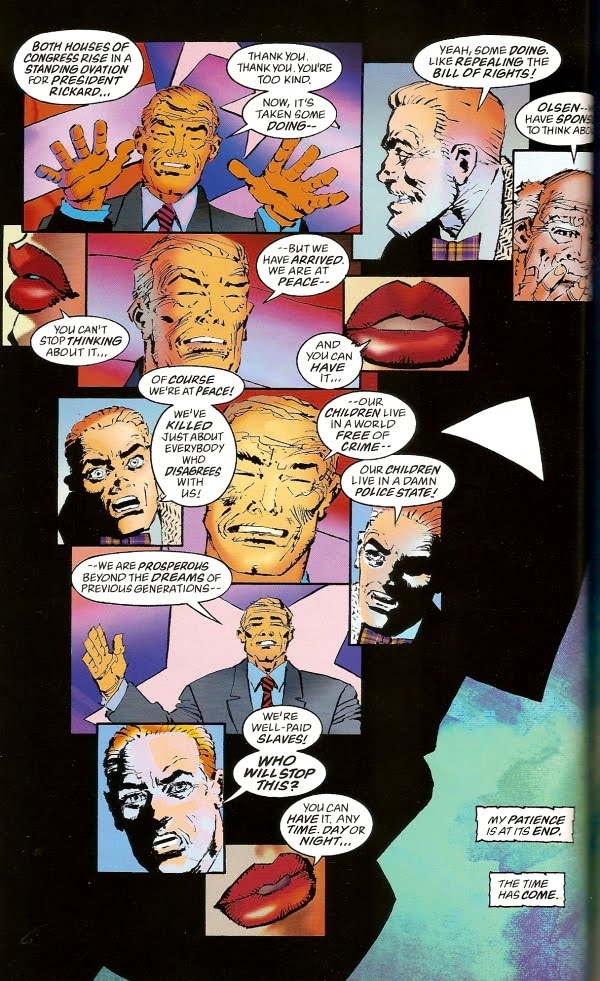
DK2 opens three years after DKR, with intriguing full page layouts featuring several interwoven TV talking heads over Batman's face. But unlike the previous story, there's no subtlety here at all. Instead we get footage of President Rickard (who just happens to have the same last name as Prez, DC's teen president from the 70's) alternating with Jimmy Olsen screaming at us about civil liberties, as if Archie Andrews had grown up to become Howard Beale.


But don't think that just because Reagan's no longer President that things have improved. No, no. And that's why Batman is planning to end his self-imposed exile. He's done hiding while the world goes to hell.

Next thing we see is some dude in a loincloth battling a hideous tentacled monster in an endless sea. He manages to kill the thing, but is then grabbed by an even larger monster. All seems lost when he is bathed in light and begins to grow. Who is he? He's Ray Palmer, better known as the Atom, and he has been held prisoner in a petri dish for lo these many years. But now a 16-year-old girl in a cat costume (Carrie Kelly, the girl Robin from DKR) rescues him from his captivity, and we can see several more ways in which this story differs from its predecessor.


The artwork is cruder, for one thing. Miller did his own inks on this one, and while Klaus Janson had never been a graceful inker, he did manage to bring a certain consistency to Miller's artwork, and even occasionally managed to emulate a bit of the old Adams-Giordano flavor on certain pages (I sometimes wonder if the Giordano influence I think I'm seeing may not have been from Giordano pitching in to help meet deadlines--unfortunately, Giordano died recently, so I may never know). Miller's work in DK2 is very inconsistent, looking pretty good on some pages, blocky and rushed on others.

And unfortunately, Lynn Varley's colors don't help things this time around. In DKR, Varley's subtle use of airbrushing brought depth to Miller's chunky figures. By 2001, Varley had discovered the computer, so instead of subtlety, we get page upon page of flashy, garish color effects. DK2 is ugly.

And not just in art. After Batman sends Catgirl on another raid to free Barry Allen (the Flash) from federal custody, we learn the awful truth: the world's three remaining legal superheroes--Superman, Wonder Woman and Captain Marvel-- are all in fact helpless victims, working for the bad guys. Prez Rickard is a hologram controlled by the real power in America, Lex Luthor (portrayed by Miller as a Kingpin-sized ogre). Luthor, working in conjunction with Brainiac, is controlling the three most powerful heroes in the world by holding Mary Marvel, the island of Themyscira and the Bottle City of Kandor hostage.


Because, you know, it's not as if Superman didn't save Kandor from Brainiac in their very first encounter, back in 1958. No, this is the post-Crisis Superman, held hostage by fear of what Brainiac will do to those poor helpless Kryptonians. Superman's whipped.

Luthor's not happy about Atom and Flash being freed, so he sends his boy Superman down to take care of things once and for all. So Superman shows up in the Batcave, at which point we get a reprise of the climax of DKR, only instead of a tragic final battle between friends who are both convinced they are right, we get this extended brutal beatdown of Superman the stooge, because Supes sux and Bats rulz, y'all. Oh, and this time, instead of a simple cameo from Green Arrow during the battle, we get Atom and Flash and GA all taking great glee in beating the shit out of their former teammate before Batman steps in to take things to a whole notha' level with a pair of kryptonite Hulk Hands.


Yeah, you read that right. Batman hits Superman with a giant KOKK. By the end of this first issue, we see that Miller has managed to ignore almost everything that made DKR great. DKR took place in a larger world illustrated through media clips, but was ultimately about one man's struggle with aging and mortality and his place in the world. DK2 was Yet Another Loud Comic Book About Guys With Powers Beating Up On Other Guys With Powers. In DKR, what made Superman's final battle with Batman great was that Superman was a good-hearted guy doing what he thought was right, and Batman was a totally outgunned underdog using his wits to triumph, barely. In DK2, Superman was a chump working for the bad guys who never stood a chance against Batman's army. DKR worked political satire subtly into the background. DK2 had characters screaming polemics at the audience.

The other problem was that it just wasn't as fresh the second time around. DKR had succeeded in large part because Miller overturned the conventions that had been stifling a stale character, took things in a darker direction than most other comics of the time, and made a lot of clever changes to established characters and relationships. But 15 years later, Miller's darker approach had become the stale convention. And Miller's plot twists, like making Luthor the power behind the President, weren't fresh anymore (at the time in the DC canon universe, Luthor actually was President).

There was still some cool stuff in there. It was nice to see Ray Palmer getting some play, because he was a character that no one at DC had known what to do with for a long time. The scene where Catgirl shoves him into her mouth was icky, but clever. The action scenes had some punch, and there was still hope that Superman would join the side of the angels again and help justice triumph.

What I'm saying is that, though it appeared as if Miller was betraying the characters as they had always been portrayed and as he had previously written them, there was still a chance that he could pull it out and make everything turn out all right. You couldn't just write him off after one issue. Sure issue one wasn't great, but it could have been worse.

It got worse. But that's issue 2, next week.

Saturday, April 03, 2010

Out of the Vault - Batman: The Dark Knight Returns, Pt. 4


So here it is, the big climax of Frank Miller's 1986 miniseries, Batman: The Dark Knight Returns. Previously: Batman returned to Gotham after a 10-year absence, drawn out by a city riddled with violence and corruption, the return of an old nemesis and a world teetering on the brink of war. After bringing Two-Face to justice, Batman defeated the leader of the Mutant Gang just before Commissioner Gordon's retirement. Then the Joker emerged for one last fiendish plot, which Batman had to stop, despite dire warnings from Superman that the federal government would not tolerate his activities and being hunted by Gotham's new commissioner. As issue three ended, the Batman was slumped against the Joker's corpse, bleeding from multiple stab wounds as the police closed in on him.

With the help of some well-placed explosives and the armaments on the Batcopter, Batman escapes the police. Robin takes him back to the Batcave, where Alfred performs emergency surgery to save his life. Meanwhile, the news is full of reports about the effect he has had on Gotham, both pro and con, including the fact that some of the mutants who saw Batman take down the Mutant Leader have now restyled themselves as the Sons of the Batman. They are acting as street vigilantes, in some cases fighting other splinter groups of the former Mutants. The opening of Nolan's "The Dark Knight" was inspired by this, with shotgun-wielding vigilantes in makeshift Batman costumes fighting drug dealers.


Then it turns out that the Soviets aren't giving up Corto Maltese so easily. They launch a nuke.


Superman diverts the missile into the desert, but the bomb is no ordinary nuke. It's called Coldbringer, and it generates a massive electromagnetic pulse, large enough to shut down electronics worldwide. It also throws a huge cloud of debris into the sky, bringing on a temporary nuclear winter, which doesn't sit too well with Superman.


See, one of the changes John Byrne had made to Superman in the reboot was to tie his powers more closely to the sun. Superman didn't just receive his powers from being in the vicinity of a yellow sun; he absorbed power from it like a battery recharging. So Miller, in a brilliant little scene, has Superman absorb the stored solar energy from the surrounding plants to regain his strength for the battle to come. It vaguely resembles the Genki Dama from Akira Torayama's Dragonball three years later, in which Son Goku absorbs chi energy from all surrounding lifeforms to power his attack.

The blackout, meanwhile, has thrown Gotham into chaos. There's rioting in the streets and an army of Mutants has escaped from jail. The police are helpless to stop the anarchy engulfing the city. But to the rescue rides the cavalry, in the form of the Batman on horseback, stitched up and barely alive.


He inspires the Sons of the Batman and the escaped Mutants to follow him and bring order to the chaos. Gotham survives the night.

A week later, it's still dark, and Bruce is preparing for the final showdown when he gets a visitor in the form of leftist radical, eco-terrorist Ollie Queen, a.k.a. Green Arrow.


Yeah, that's right. After three issues in which Batman has battled crime and corruption and the worst of his rogues' gallery, along with the new menace of the Mutant gang, the final showdown of Miller's series is not with another villain, but with Superman, the biggest big gun of the DC Universe, its most incorruptible hero, and (before the reboot at least) his former best friend.

And once again, at least for me, seeing this fight was like seeing something I didn't know I wanted to see until Miller showed it to me. I mean, yeah, comics fans love to speculate on fantasy match-ups, but it was usually something that you knew you would never see--who would win in a fight between Superman and Hulk? Answer: probably Superman, but you never knew, because Hulk gets stronger when he gets madder. Who would win in a fight between Superman and Thor? Answer: pre-Crisis, probably Thor, because Superman is vulnerable to magic, so Mjolnir would crush him. Post-Crisis, who knows? (in the actual crossovers between the two companies, the answer came out Superman, both times).

But I don't remember ever speculating about Batman vs. Superman, because number one, they were buddies so it would never happen, and number two, it was ridiculous. Batman would have no chance. At least, the 70's Batman who relied on his fists and his Batarang on a rope would have no chance. And before the fight, even Batman acknowledges it in his farewell to Robin, which brings us back to the theme of Batman's impending death that has been hanging over the series since page one.


But here was Miller's Batman, smarter, more ruthless, and using his vast fortune to compensate for his mortal limitations. Batman taking on Superman, pulling no punches and actually winning. Good God!


At least until his heart gives out. Batman gets the good death he's been pining for. At the funeral, though, as everyone else is leaving, Clark Kent hears Batman's heart begin to beat under the ground and realizes this was all part of a plan to kill off Batman for good and allow Bruce to start a new life. And with a wink at Carrie/Robin, Clark shows that he's on board.

Bruce ends the book in subterranean exile, with Ollie and Carrie and a force of former Mutants, building an army, establishing a legacy.

All in all, Batman: The Dark Knight Returns was a remarkable achievement. On the one hand, it brought a new depth and interest to the character of the Batman, who had grown stale and bland over the years. This new Batman was nothing like the staid Super Friend or camp icon of years previous. And this newer, darker Batman has influenced every depiction of Batman since, from comics to TV to the big screen. It was also a meditation on age and regrets, life and death, the invulnerability of youth and the inevitability of death.

And on another level, it was a story about heroes and myths and the power of symbols. Batman stands outside society, above it, not a god like Superman, but simply a man who refuses to compromise or submit or play by the rules. The villains can't corrupt him, and the police can't stop him ("He's too big," says Gordon, a view that his successor Ellen Yindel comes to appreciate when the blackout hits and the institutions fail and there's only Batman to bring salvation). And it stands in really interesting contrast to Alan Moore's Watchmen, in which Ozymandias similarly sees himself as above and outside the rules.

And then there's the final battle between Batman and Superman. This is not your average hero vs. villain slugfest, but a philosophical debate rendered in punches, Batman's refusal to compromise pitted against Superman's go-along-to-get-along philosophy. And what makes it powerful and tragic is that each man is right in his own way. There's no hero, no villain.

It was a powerful story, a tour-de-force of comics storytelling, perhaps the best thing Miller had ever done, and it helped change the comics business forever.

And then, 15 years later, Miller came out with a sequel. More on that next week.