
Here it is, after midnight. I'm supposed to get up at 5 in the morning, as I do every morning that I work, but I stay up till past midnight to update Hero Go Home. The image gallery on the front page is cool, but it doesn't update automatically. Every morning, I have to update it by hand--replace the image, replace the link taht accompanies the image, and add a line of code to the previous chapter of Run, Digger, Run! so you can click through to the next episode.
And the thing is, on the one hand, I'm terribly disappointed in myself. I had intended to be worked ahead with a comfortable buffer on the daily episodes, but instead, I'm barely getting each week done in time. I have episodes done through Friday, but I don't have next Monday's started yet. I barely have any outline notes. And I still need to sacan pages for Satuday's Vault and watch Blade II and do screen caps for Sunday's Super Movies. Not to mention all the sound editing I still have to do on the podcast dropping next Monday.
And yet, I feel pretty good. I spent a lot of time sound editing today. I'm starting to remember why it's taken me a year to get back to this again--it's a ton of work and frustration--but it's also fun. And I think I put together a good graphic for this week's chapter. Last week's was a little boring, but this week's is nice.
The big problem is, I'm still not generating traffic or money. I think I'm getting better at the serialization thing, and as I get further into the story, I'm hoping to generate more exciting chapters. So far, I'm worried that it has been a little uninvolving. Part of that is the nature of the format. Five hundred word episodes don't allow for a lot of emotional exploration. But as the story builds, I hope to make it more gripping. And the blanks are starting to fill in. For instance, this last week I figured out what the final scene will be. There's still almost fifty weeks between now and then, but I know where I'm headed now.
Seriously, as worried as I am that I'm dancing right on the edge, I'm also jazzed, because it looks as I'll definitely make it through the first month with 7-day-a-week posts on time. And if I can do it for a month, it's possible that I can do it for a year. And if I can do it for a year, I might actually be able to build a following and make some money. I hope.
Monday, October 24, 2011

Friday, October 14, 2011
Channeling
Today, I channeled the ghost of Arch Oboler and wrote what seems at first blush like an almost note-perfect Lights Out. The funny thing, of course, is that I wrote most of it during my shift at Target, muttering scenes under my breath as I was scanning shelves and stocking merchandise. I'm probably not the only Target employee ever to spend an entire day mumbling about murder, but I may be the first to do it for a radio-style drama. We'll see if it's actually any good on Halloween.
Tuesday, October 04, 2011
Gaming, Spoilers and Expectations in Writing
So last night we had a gaming session, and though not a lot seemed to happen, I came away from it pretty happy. It's tough with a new gaming world to find your place in it right away. It takes awhile to learn how the new world works. When I was in college, it was easier: a big fight against a cool-ass monster or villain, then phat lootz after, and I'm happy.
It's different now. I'm older, and I place greater value on different things. And our group is made up of writers and avid readers, so much of the joy of the game comes not from big combats, but from moments between characters who have revealed themselves over time. Last night, I had a pretty good moment with lots of conflicting emotions crammed into a relatively brief period of time. I wish I could get something that complex and interesting on the page.
And thinking back over it today, I realize that part of what made it work was that I had set up some expectations earlier. Essentially, what happened was, my character appeared to give another a hug. And in the moment between initiating the contact and explaining what it was about, there was a tension between several alternatives. Was he doing this as a lost child needing comfort (since he had explained that he had no memories beyond a few years previously and had been wandering the fringes of society for as long as he could remember), or was this perhaps a more romantic gesture (since another personality controlling his body had hit on the same character the previous night--perhaps there was a secret crush or something)?
The reveal, when it came, managed to be both creepy and pathetic, and I hope was a surprise, upending the expectations set up while also (I think) satisfying them in a different way.
This plays into a theory I've had about writing for a while now. The trick--the really hard trick--to writing a story that works is to set up expectations and then satisfy them without satisfying them.
What?
An example: in the mid-1970's, Ralph Bakshi directed an animated film called Wizards. It was a satirical look at fantasy and sword-and-sorcery about the clash between the good hippie fairies led by the wizard Avatar and the dark forces of evil led by Avatar's evil brother, Blackwolf. It is set up in the beginning that these are the two most powerful wizards on the planet, so we know, we expect, that there will be a climactic duel between the wizards. And although it seems as if Avatar's powers are all bluff throughout most of the film, we hang in there waiting for him to bust out his Moment of Awesome, because we've been told that he's actually really powerful.
But the confrontation, when it comes, is over almost before it starts, because Avatar pulls out a gun and just shoots his adversary. And yeah, it's funny and it's a shock, and it's in keeping with Avatar's character. And yeah, this exact bait-and-switch is one of the most fondly remembered moments of Raiders of the Lost Ark, which came out four years later.
But the key difference is, in Raiders, it's a throwaway joke against a character we've never seen before. We had no real expectations. In Wizards, we'd been watching Avatar travel to this confrontation for an hour-and-a-half, only to settle for a swift kick in the balls. Now, knowing it's coming, I can appreciate the joke, but the first time I saw the movie, I was pissed off. Because I hadn't received what I thought I'd been promised.
And I wonder if that's part of what went into a recent study which found that spoilers do not actually ruin a story. I like surprise twists in a story, but obviously a story that depends wholly on surprise cannot become a perennial favorite, enjoyed over and over again. You can only be surprised once.
A well-told story is like a series of promises from the author--"Okay, you don't know what this means, but I promise, hang in there with me and it will mean something later, and it'll be cool, I promise!" So if you promise a fight, there needs to be a fight. If you promise love, there needs to be love. If you promise a solution to a mystery, the mystery must be solved.
But there's a trap, which is that you can't meet their expectations too square-on. There's a reason why the words "dull" and "predictable" so often go together. The story needs to be predictable, but in a surprising way, a way that lets the reader or viewer feel smart while also appreciating the author's ingenuity--"man, I knew something like that was going to happen, but I never thought it would happen like that! That turned out way cooler than I expected!"
It's a delicate balance, and one I'm always trying to do better.
Monday, October 03, 2011
It's ON! Run, Digger, Run!
The new story launched today. I'm not worked nearly as far ahead as I'd like, but it has taken me a while to get into the rhythm of the short daily clips. I'm hoping it will get easier as I get more used to it.
Sunday, October 02, 2011
Misogynistic Joke of the Day
In the party supply section at Target, they have boy pinatas and girl pinatas. Boy pinatas, we're all familiar with: hit them hard and candy comes out.
But you are not allowed to hit the girl pinatas. You must instead get them drunk and promise to love them forever, then see if they'll give up the candy voluntarily. Afterward, you have to promise to call them.
But you are not allowed to hit the girl pinatas. You must instead get them drunk and promise to love them forever, then see if they'll give up the candy voluntarily. Afterward, you have to promise to call them.
Sunday, September 25, 2011
The Children
Had an impromptu bad movie night the other night. We watched the 1980 horror film, The Children. And yes, it is still wretchedly bad.
But bad in interesting ways. The story in brief: a school bus carrying most of the kids from the small town of Ravensback passes through a cloud of toxic gas that leaked from a nearby nuclear plant. The exposure turns the kids into zombies with black fingernails with only one desire: to hug people. Unfortunately, their hugs kill the recipients. They burn until they are half-melted, unrecognizable husks.
So yes, it's awful. Filmed on a low budget in a small town somewhere (but a small town with some huge houses--maybe a suburb of a larger metropolitan area), there are no stars. Not one. Not even a cameo by a minor B-list celebrity has-been to pique an audience's interest. The script is awful, and the acting is worse. But it is not entirely amateurish. There are a few stylish shots, and some camera movement.
And the score is interesting. In places, it's reminiscent of the Friday the 13th movies, minimal keyboards with a hollow echoey feel, which just makes sense because the score was written by Harry Manfredini, who scored the Friday the 13th films. But in places, he also "references" (or rips off) Bernard Hermann and Leonard Rosenman. It just seems odd for this low-budget little piece of nothing to have an orchestrated score, even if it is just strings and keyboards But this was before synthesizers became ubiquitous.
Directing choices are also strange. The movie introduces us to many residents of the town, and it seems as if a lot has been left on the cutting room floor. Two women living together, one of whom seems really angry at the sheriff, for some reason. It looks like there's a history there, but it's never explained. Another rich woman is set up to be a major subplot--she shares a fairly big scene with the sheriff, and later, someone coming to see her is able to talk his way past a police roadblock--but then she disappears. we never hear from her again, there are no consequences to her scene with the sheriff, and her body is not even discovered when the sheriff visits her place later. The other people with her are found dead, but she's just gone. It just feels like a lot of stuff got left on the cutting room floor.
But as Sargon aptly observed, it's not as if they had no time for character stuff. Much of the running time is filler, dead space, as characters get in their cars, turn around, and drive into the distance, just so we know they're going someplace.
But perhaps the most fascinating thing about the film is the subtext. Stephen King in Danse Macabre talks about how horror movies often have a subtext that serves as an accurate barometer of what concerns society at large--Cold War paranoia, economic concerns, the Generation Gap. And that might be true for movies that are broadly successful. But what about a movie that found little to no audience?
Might it just be a look at the filmmakers' private fears? And what does it say about the filmmakers in this case? I mean, you could look at it really abstractly and say that it all about people we should trust implicitly being our enemies or something, but at base, the monsters are little kids who want hugs! What about that spelled "terror" to Carlton Albright and Edward Terry, the credited writers?
Saturday, September 17, 2011
Casting Call for Halloween '11
I've finished a first draft of this year's radio script and am now looking for voice volunteers. Details are on Hero Go Home here.
Monday, September 12, 2011
A Story About Theme
There's a thread running over on Codex about themes in writing, with basically two camps developing: one side that basically says, "I never write with a theme in mind," and another that says, "I never write without a theme in mind." And I 'm pretty much in the former camp.
When I was in film school, I took a class (actually, I ended up taking it twice and never passed) in which you had to make 5 short films. So comes the week my third film is due, and I have nothing. I get up on Sunday, realizing I have to get the thing planned and filmed that day in order to send it to the lab on Monday, get it back and edit it on Wednesday and turn it in on Thursday.
So I end up doing a TV commercial sort of thing, a pure exercise of movement and music, with no actual story to speak of. I draw my hand writing out the word "Canon" in pencil and then going over it with ink, with the idea that I'll then play Pachelbel's Canon along with it.And to make it visually interesting, I filmed it in short cuts of ultra-close-up with the paper backlit. Substitute chopping vegetables for drawing a word and it would look like any number of TV commercials. But after I had it edited, I realized that Canon was too slow and made it drag, so I substituted an upbeat Mozart concerto instead. So now it really had no meaning.
Now, the way the class was set up, after you showed your film, you had to sit silently while everyone gave their crits, and then you could respond at the very end, after everyone had their say. So for twenty minutes, I sat there while person after person waxed enthusiastic about my film and tried to tease ever more elaborate themes from it. Then when it was my turn, I told them that it was just an exercise in sound and motion, with no more theme than "Fuck, I've got a film due." And then I had to listen to them get angry for twenty more minutes for shitting all over their thoughtful criticisms.
I've always envied the people who can write a story that says something fundamentally important about the human condition, even if I disagree with it. The fact that I've never really been able to do it with any kind of conviction has always struck me as a lack within myself--I don't write stories with messages because I have nothing useful to say.
However, over time, I find I've grown less patient and less impressed with stories that try to preach a worldview to me. Death Wave and Hero Go Home might be superficial and without overriding themes that would make them into good English Literature 101 fodder, but at least they don't fall back on the evil faceless corporation, the evil secret government program, the evil military, the evil televangelist, the noble outsider deciding that other=righteous, "true love conquers all," or any of the other simplistic nonsense that makes up most of what I see and read. I can live with that.
Saturday, September 10, 2011
A Very Apt Metaphor
Cracked.com is funny in a way that Cracked, the magazine (which in my youth was always just a lame Mad wanna-be), never was. Sometimes they pile it on a little thick, and sometimes I disagree with them, but that's a risk with comedy. The point is, in general, it's a fun diversion of a site that you never expect to say something profound.
But this...
But this...
In an online world, your writing is going to form a shell around you, and most of the people who interact with you will only see the shell.Is profound. The rest of the article is good, too.
Tuesday, September 06, 2011
Did I See This Wrong?
So the other day, I'm at work, standing near the front doors. And there are these two teenage girls standing sort of huddled together looking at something on the floor. And they turn to me and ask, "Is that real or is that a toy?"
So I look down, and there's a big spider. Not tarantula big, but probably the biggest non-tarantula I've ever seen. The legs are spindly and smooth, not fuzzy, but the body is about as long as my thumb and a little thicker. And yes, I have small hands, but still...
The point is, it's so big that it looks like a toy spider, and it hasn't twitched. But it's not obviously rubber. So I nudge it with my shoe, and it starts crawling. And the girls squeal and by the time I've turned around to tell them, "Looks real," they're long gone. Not that I totally blame them, because they were wearing short shorts and I hear that spiders sometimes jump.
So the aisle of dollar-crap is right there. I grab a couple of small cardstock baskets, drop one on top of the spider, then use it to scoop the spider into the other one and trap him in between. And after a pause to show the guy at the Guest Service Desk my catch, I take it outside and away from the doors and dump it.
And this is where it gets weird. Because it hits the ground and suddenly, I see the ground is crawling with little tiny bugs the same color as the spider. I mean, it's like the spider had been covered with little tiny baby spiders who suddenly decided to all jump off at the same time, or maybe were knocked off when the spider hit the ground. Except that I've never heard of this, and saw no baby spiders on the floor in the store or in the baskets after I dumped the spider out.
So maybe it was just a coincidence and there was a colony of tiny ants or something in exactly that spot where I dumped the spider. What I do know is that the spider immediately crawled away, but not towards the doors, so not my problem.
Thursday, September 01, 2011
It's Here! Hero Go Home Ebook Now Available

Okay, that last one was a lie. It's a prose novel, and it's $3.99. But all the rest, seriously. Go read it.
Find it at Smashwords here. I'll get the Amazon Kindle link up as soon as it finishes churning through Amazon.
ETA: The Kindle version can be purchased here.
Tuesday, August 23, 2011
On the Launchpad
New character is all ready to go--stats rolled, background written, skills and gear purchased. I know pretty much who I intend him to be. Now to see who he will be.
Tomorrow night...
Tomorrow night...
Saturday, August 20, 2011
Strange Inactivity
Feels strange to be sitting at home tonight. I've spent the last five nights out of the house, plus Saturday nights are often movie nights with friends. However, we had movie night on Thursday, so now everything feels skewed. I just feel as if I should have somewhere to go, and I don't.
Which is not to say I don't have things to do. I have a ton, and a nearly unprecedented 4 days off in which to do them. Bad in terms of hours worked this week, but good in terms of having time to get caught back up on life. I need to start reclaiming the house from the mess that engulfed it after the heat wave clamped down on us. I need to put together some eBay sales for my dad. I need to finish editing Hero Go Home and finalize the cover. I need to get a lot of work done on the Hero Go Home relaunch: settle on one of the potential new themes I've been playing with for weeks, and finish up the new logo, as well as designing the look of some new featured graphics. And write a new Movie Monday, as well as working my way ahead on Out of the Vault.
Oh, and set up a plan for Halloween. Since Hero Go Home is now the official location for all Blog Events, the big festivities will happen over there. I have a short story written that I'm going to adapt into a new radio play (hard to believe it has almost been a year, already). I'm going back and forth between Non-scary 70's Horror and Superheroes Who Are Really Monsters for the Out of the Vault theme. I don't have a theme for Super Movie Monday yet; maybe some 70's British stuff like The Abominable Dr. Phibes, or maybe (as a companion to Out of the Vault) Superheroes Who Are Really Monsters, like Blade and Ghost Rider (which is unbelievably getting a sequel--you can see the trailer here).
I probably won't get it all done in four days, but I hope to get some really big chunks done. Good intentions and all that...
Wednesday, August 17, 2011
GIMP Tutorial and Game Preview
So I used GIMP to put together a really quick and dirty portrait of my new character in the new game campaign, and thought I would throw up a quick tutorial on how I did it. I'm not going to give all the menu paths and such; generally, selection tools are under the Select Menu, Gaussian Blur is under Filters>Blur, and the layer modes are on the Layers dialog under Windows>Dockable Dialogs.
I took as my model this photo of actor Corbin Bleu, best known for his role in the Disney Channel's High School Musical movies. He has matured into a handsome young man, and between the hair and the well-defined planes of his face, he looks a lot like the character I see in my head.

STEP 1: I used the Path tool to copy him out of the background and paste him on a new layer. There are some complicated methods using high-pass filtering to preserve the detail of the hair and such, but in general, I find it faster and easier to simply define a path around the figure, Select From Path, Invert, and Cut, then use the eraser to do fine clean-up. I will usually then Select by Color the transparent portion of the layer, grow the selection by 3-10 pixels (depending on how big the photo is) and run a Gaussian Blur of 2-3 pixels to eliminate the sharp edges to the image that are a telltale giveaway that the person has been cut and pasted.

This was a quick-and-dirty conceptual piece, so I didn't do as much clean-up as I could have on his hair and neck/shoulder areas, or the gap between his chest and his right hand. I also cloned out the necklace, although not completely.
STEP 2: I added a desert background, then flipped it to make the angle of the light more closely match that of the Bleu photo. Then because my character is of a non-human race with golden cat-like eyes, I needed to change Bleu's dark brown eyes to match. First I selected the area of Bleu's eyes, cut and pasted to a new layer, then erased everything except the irises. I desaturated the image so it was black and white, then upped both the brightness and contrast until the brown area of Bleu's eyes (hardly noticeable unless you're looking at extreme magnification) was quite bright. Then I used a small brush to paint in black, darkening the pupils and extending them into catlike slits.

STEP 3: I added another layer just under the one with the copy of the irises and painted in yellow over Bleu's irises. Most irises darken at the edges, so I left a little gap between my yellow and the edge of the iris to provide an outline (I've hidden the other layer so you can see the color more clearly).

STEP 4: I set the layer mode of the iris copy to Hard Light. This allowed the natural patterns of light and dark in Bleu's eyes to overlay the yellow color I'd painted in, making a realistic looking eyeball with shadows that match the lighting in the base photo.

The eyes look a little bright and artificial at this point, so I reduced the opacity of the color layer to about 60% and the overlay to about 80%, which made the effect more subtle and natural-looking.

STEP 5: I had the eyes looking pretty good at this point. The problem now was the color. The original photo had been taken indoors, while the background was saturated in the warm colors of sunset. So I added another layer, did a Select by Color on the transparent portion of the figure layer, followed by Invert Selection. Then I filled the selection with a tone which I thought would give a good match and set the mode to Overlay. It wasn't quite right, so I fiddled with the Hue and Saturation sliders under the Color menu and played with the Opacity until I had something I liked.

STEP 6: It still didn't look right, though. Notice that on the background image, it appears to be taken at sunset, and the shadows are very deep and black. So I needed to deepen the shadows on the figure, while making the highlights pop. I couldn't simply change the contrast on the figure, because that would also change the hues, making them garish. So I copied the figure and pasted it to a separate layer above my color correction layer. I Desaturated the image, then ran a Gaussian Blur. The figure was large, so I may have gone as high as 10 pixels on this. Experiment with what works best. I erased out the irises to allow the eyes I'd worked so hard on to show through.

I set the mode to Overlay and kept the Opacity at 100%. Notice how it makes the shadows deeper and the highlights brighter without changing the overall hues. The blur also has the added benefit of smoothing out the skin tones and giving everything a slightly alien sheen. I probably could have done this better and more easily with an Alpha Channel or something, but I still don't understand channels, so I stick with what I know.

STEP 7: At this point, I was pretty happy with the result, although I figured I would add some processing to the overall image to add a subtle iris effect to focus attention on the focal point of the picture. I usually do this on a separate image, though, so I saved what I had to a separate JPG, then added the iris effect for the final result.

I intend at some point, once the game has begun and the character has taken better shape, to do a better portrait. But as a quick-and-dirty picture that was completed in an hour or two, this is not bad, and the basic techniques are applicable to a wide variety of situations.
If this kind of article interests you, let me know and I'll do some more. I'm no expert, but I've learned a few tricks here and there, and I'm glad to share if it does someone some good.
Sunday, August 14, 2011
The Other Smeaton
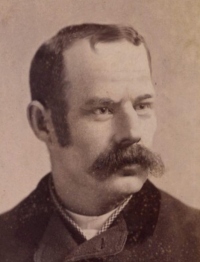
So I thought I was done with the Dougal Smeaton posts, but turns out, I've got at least one left in me. I am excited about our new campaign and about my new character in it, but I notice that I still break into the Scottish accent every now and then for no damn good reason except I miss the big brute, I guess.
But here's the thing: I've mentioned this before, briefly, but he wasn't the only character I had in mind when we were setting up the campaign. I actually proposed two characters, and Dougal was the one who seemed to fit best with the rest of the group as it was taking shape. And since naamah mentioned publishing some of her initial notes as she was putting together Tom Gentry, I might as well do the same thing with the Smeaton who might have been. So here is my intial email to sargon proposing two character ideas.
Like I mentioned Monday, I had a character idea leap into my head while we were talking. Then as I was driving to see my daughter last night, it occurred to me that the group may have too many of one type or other character, so I came up with another. And no matter which one you pick, the other may be useful. So let me present the Smeaton boys.
Dougal Smeaton is the older of the two Smeaton brothers. The Smeaton family runs the Glenellon distillery near Aviemore along the Spey river. Dougal grew up around the boilers and condensers used to make the family product and experimented with steam machines when he grew older, an enthusiastic amateur like so many who helped drive science and invention in those days. His skills with machine tools and engine design are not fully developed yet, though he is an expert when it comes to boilers and pressure systems.
But when was old enough, he joined the Royal Highland Regiment (The Black Watch) or whatever Scottish unit you might have that would get him to Atlantis. He's a big man, strong, stalwart and intrepid. A trained soldier who also knows a little about steam machines and is eager to learn more.
His younger brother Torin Smeaton is a different character altogether. He also grew up around the family business, but was more interested in the product of the distillery than the equipment used to make it. He was fascinated at the thought that barley could be transformed into something entirely different. As soon as he was old enough, he began to travel to other distilleries in other countries, learning more about the art of distilling spirits. In Italy, he discovered that different herbs could be used to infuse multiple flavors into a product, such as Strega:
http://www.strega.it/store/product_info.php?cPath=1&products_id=1&language=en
He also had a brief affair with mysterious Italian woman (at least he thought she was Italian--they met in Italy), who introduced him to more exotic herbs, herbs which acted on the mind and psyche. In attempting to learn more about these substances--telling himself it was only to develop a new product for his family's company--he traveled to Atlantis in search of herbs unknown in Europe. In Atlantis, his studies on herbs brought him into contact with students of the Dark Arts, and almost without consciously deciding to do so, he found himself learning magic instead. When he looks back on it later, he'll wonder if perhaps his winding path was actually directed from outside, by Fate or by some other Power.So there you have the forgotten Smeaton, as well as a first look at what would eventually evolve into the Smeaton we now know. Sargon expressed a preference for Dougal and suggested that he might be an officer for greater latitude of action. But I saw Dougal as more of an NCO. Which led to a bit more exploration of his possible background.
Thinking about this further, the Coldstream Guard/1st Atlantean Rifles obviously is the way to go. If there's any kind of technology exchange with Atlantis or something, he might have joined for that reason, which would have caused some hard feelings with his father, who would have preferred he join a Highlands unit..
As far as his age, I'm thinking he's probably mid-20's, like 25 (Torin is younger, closer to 21 or 22). And as far as freedom of action, what if he had been cashiered from the service, dishonorably discharged for some offense he didn't commit. It wasn't bad enough to get him thrown in jail, but it was bad enough for them to dismiss him (or maybe it _was_ bad enough to throw him in jail, if the case against him had been stronger). So he's military-trained, but not actually serving. Too broke to go home (and his Dad might not welcome him back with open arms anyway, after leaving Scotland to join some crazy Atlantean unit, then getting thrown out for dishonorable conduct).
As far as his military job, I don't know enough about the tech level of the Rifles to speculate. Maybe artillery or a mortarman, or a driver of some sort if they have war machines. Crewing one of those would have improved his engineering knowledge, also, I would think.
Best ideas I can come up with without more detailed knowledge of game world.
There was a little more back and forth, but it was mainly about what kind of engineering he might be good at. Finally, by the first game day, we had a more-or-less finished character: Dougal Smeaton, ex-artilleryman, engineer at the Phoenix Steamworks, engaged in building a steam-powered submersible for Sir Walter Graves and then pressed into service to help find him. It took a few weeks to really find his rhythm, and then it was a really fun ride. I can't imagine how the group would have looked with Torin in there instead.
Thursday, August 11, 2011
I Should Be Writing
SO I've got a ton of projects that need doing, but I can't concentrate on any of them, because I'm getting so revved up about starting a new game. I was a little iffy on the concept of the campaign world when it was first being described, but now my character is really starting to take shape, and I think he's got the potential for about eight different kinds of cool.
I've got the basic parameters of the character mostly figured out. There are some setting-specific details that need to be ironed out, either by me or by the gamemaster. I've tried to set him up so that there are some mysteries in his background that may or may not come into play down the road. I've tried to set it up so that he can be interesting both in and out of combat, while also being totally different from either Cole Chen or Dougal Smeaton (for that matter, he's not really like any character I've played, although he shares some similarities with a couple).
It's been fun coming up with his personality, his history, his abilities and the way they fit together. It's fun imagining what kinds of scenes he might play with other characters, to help me define his personality more clearly in my head. But he really won't take full shape until we're actually playing and he has other characters to react to. And that's one of the coolest parts, because at that point, I'll really be getting to know him at the same time as everybody else.
Monday, August 08, 2011
It Wasn't All Perfect
One might get the impression from past posts about the Atlantis campaign that it was some sort of perfect experience. Of course, it wasn't. So just what sorts of problems were there? I mention these not to be a buzzkill on our fond memories, but just as a reminder of things to watch out for. If I ever do get my nerve up to try to run a game, I will want to keep these things in mind myself.
One continual worry of mine at the prospect of running my own game is the fear that I won't be able to provide enough interesting things for the players to do. That was not so much a problem in Atlantis. In fact, we sometimes had the opposite problem: too many things going on simultaneously.
For instance, when the group returned from the Ghul city, we had several sub-plots going at once. We had come back with a ton of treasure which we had to deal with (and never actually did--the game ended with a ton of golden artifacts still locked up in a room of the late Lord Waugh's estate, assuming no one had just come in and looted it). Victoria had come up with a plan to marry Lord Acrisian, so much of her time was involved in planning that. In addition, someone had sent assassins to kill Victoria, so there was a lot of running aroud trying to figure out who had done it, which dovetailed with the wedding plans.
At the same time, Smeaton was seeing the princess in the tower while trying not to get sidetracked from what was supposedly our main quest to finish the submarine and go hunting for Sir Graves. Gentry's messing with this mirror he got, and Amice is trying to figure out what to do about the hydra goddess we had bargained with.
And the whole time, the gamemaster is trying to throw out these hints about deaths down by the shipyards, but no one is taking the bait, because we all had a dozen other things to worry about, and frankly, with that group, you needed a little more to motivate them than "I smell a mystery. Come on, gang." And eventually, I decided to go ahead and pay attention to the ever-more-obvious signals that the waterfront thing needed looking into, and it led to a good series of encounters. But there may have been a few too many balls in the air at that point for us to focus on the one he wanted us to focus on.
Which leads to the ever-present question of railroading. This is a tricky subject, because on the one hand, as players, you don't want to be led by the nose. But on the other hand, especially in the early game, you don't know enough about the world and your characters to act confidently. You need to be led a little and shown what the possibilities and parameters are. And if the gamemaster has gone to the trouble of preparing an adventure, it kinds of sucks for everybody if you deliberately avoid it. Now he's just wasted a ton of effort, and probably not happy about it, while you're sort of wandering around at random wondering why nothing really interesting is happening. Um, it's because you decided to avoid the interesting thing, genius.
But having said that, it became a little obvious at times that there were tracks that we just weren't going to be allowed to go outside, which got a little frustrating sometimes. And there were a lot of situations that were just so complicated, where we really didn't know enough about all the pieces of the problem, where we would just be lost. Like planning the defenses of Avalon and Atlantis. To really set up the defense correctly would have required maps and detailed order of battle information, and a series of encounters sending out scouts and probes to get intelligence back, which would have stretched things out interminably and probably bored the hell out of the other members of the group. And what the GM would almost inevitably fall back on was an NPC channeling Sean Connery and saying, "Perhaps I can be of assistance." The NPC would detail the plan, and we would just sort of say, "Yeah, let's do that. Tell me when to roll dice."
Which ironically is why it's a good thing all these RPG fantasy worlds look mostly the same. The more unfamiliar the world is, the harder it gets to figure out your options. A good thing to remember for my own game if/when I ever run it.
And then there was the Dawn Forge. Great concept. Wonderful, impressive movie moment as we go in and see this incredible device with the glowing plasma discharges and all. But then we try to use it, and are required to roll dice.
And here's the thing: there was no reason to roll dice, except to make it feel gamey. There were no consequences to failure. There was no way we were going to spend a year-and-a-half getting to this thing, only to die because of a random bad roll. And the gamemaster wanted us to have kewl gear as much as we did. So failing a roll didn't mean you couldn't have the gear. It only meant you had to roll longer to get it. Which made it all kind of pointless. If there's no prospect of failure, why bother rolling at all?
On an almost totally unrelated note, I found out that while my daughter was off visiting my mom this past week, she printed out the rules to a role-playing game. It's a very simple one, looks like, that uses chips instead of dice. Instead of rolling dice for skill or combat resolution, each task has a difficulty, and as long as you have a skill level high enough, you succeed (you also have a pool of chips to buff up certain skills-- not having read the rules thoroughly, I think the challenge level remains secret from the players, so you can fail if you fail to bid enough chips to perform the action or something).
On the one hand, I think it's really cool that she's interested in my kind of gaming, and part of me would like to play the game with her and share that experience. However, it's based on the Warriors books, and I just don't know how much patience I would have playing a game about a tribe of feral cats. Urgh. Difficult question.
Sunday, August 07, 2011
A Farewell to (Hairy) Arms
So this is it, the last Smeaton post (probably). This will be long, but I want to get it out, so bear with me.
The Atlantis campaign is officially over. We played the last real session on Thursday night and had a brief epilogue/wrap party last night. Scotch was sipped, secrets revealed (more plotting to kill Smeaton by the other party members than I was totally comfortable with, actually--don't blame them, but still...), and songs were sung. There ended up being a total of thirteen song parodies inspired by the game, which is just... Oh god, I'm almost a filker. It's seriously embarrassing. It may have been one of the dorkiest evenings I have ever spent in my life, which is saying something, but it was also one of the most fun.


As well as a few side porn stories for the ladies, the copious notes written up by the GM for campaign background including a world's worth of locations and a huge cast of NPC's. And then there were my own piles of research for Smeaton, including research on making Scotch, info on early submarine designs, research on period poetry, and even a full manual of light artillery from 1896 I found on Google books. Oh yeah, and the recipes. Seriously. (ETA: And how could I forget that bat-cheva recorded something like the last 10 months of game sessions? Or the CD of soundtrack music and naamah's description of the game's proposed movie trailer that inspired me to construct an audio track of my own version of the trailer?)
 And the thing is, it wasn't clear from the start that things would turn out so well. Our previous superhero game had been wildly fun, a laugh-a-minute gonzo ride through space and alternate dimensions. But for the new game, we were not only taking a more serious approach, but also adding two new players, efamar and jormungandr. Jorm had played years ago, but not recently, while efamar had not really gamed at all. Bat-cheva had only one campaign under her belt, and sargon and naamah had been gaming solely with each other for years, and so had developed a very personal gaming style that might not translate to a bigger group.
Because this game was something special to all of us, I think. Besides the 13 song parodies, the game also inspired faux tintype portraits, physical props, various other illustrations including portaits of efamar as her character:

Smeaton's original, but too small and plain, sub design:

And Smeaton's letter to Gentry after the night of the demon battle:

As well as a few side porn stories for the ladies, the copious notes written up by the GM for campaign background including a world's worth of locations and a huge cast of NPC's. And then there were my own piles of research for Smeaton, including research on making Scotch, info on early submarine designs, research on period poetry, and even a full manual of light artillery from 1896 I found on Google books. Oh yeah, and the recipes. Seriously. (ETA: And how could I forget that bat-cheva recorded something like the last 10 months of game sessions? Or the CD of soundtrack music and naamah's description of the game's proposed movie trailer that inspired me to construct an audio track of my own version of the trailer?)
 And the thing is, it wasn't clear from the start that things would turn out so well. Our previous superhero game had been wildly fun, a laugh-a-minute gonzo ride through space and alternate dimensions. But for the new game, we were not only taking a more serious approach, but also adding two new players, efamar and jormungandr. Jorm had played years ago, but not recently, while efamar had not really gamed at all. Bat-cheva had only one campaign under her belt, and sargon and naamah had been gaming solely with each other for years, and so had developed a very personal gaming style that might not translate to a bigger group.
The early sessions were erratic, trying to find our place in the world and our dynamics as a group. Efamar was very shy and unsure, jorm's character had trouble finding his niche, and bat-cheva felt unequal to the leadership role she found cast upon her. As for me, it took me a while to find Smeaton's voice, but between the first moment I obeyed the impulse to have Smeaton deny the reality of magic and the time I gave the speech about Smeaton's goal in life--selling Smeaton's Own Steam Man whisky from town to town back in Scotland--I think he fell into place.
 And about the time jorm dumped Dr. Travis for Strego, the entire group began to click and things got seriously fun. And now we're looking at the next game with some anticipation--because though we loved Atlantis, I think we were all ready to move on--but also with some trepidation, because what if we can never recapture that lightning-in-a-bottle thrill we got during the best parts of the Atlantis game?
Sargon is unsure of the campaign setting he wants to run. I had been planning to propose taking my own turn GMing after Atlantis ended, but I'm barely keeping up with my blogging commitments now. I don't think I could sustain a decent campaign as things stand right now, though I am keeping the notes I've prepared in case circumstances change and I want to try at a later date.
One of the coolest things about the game for me is that the game ended, in dramatic terms, with a kiss between Smeaton and Amice, his secret crush for most of the game. Games are played in basically two modes: dramatic mode, when players speak as their characters in scenes of discussion or action, and narrative mode, when time gets compressed and information in discussed at a higher impersonal level. And as far as I can remember, the last actual scene was between Smeaton and Amice. In a movie, it might look something like this:
Amice plunges the enchanted dagger into Smeaton's chest. He jerks and gasps as magical life flows into him. His eyes fly open to see Amice sitting in his lap--covered in blood, still flushed and panting from the battle, her concerned face only inches from his own, her eyes gazing into his.
Impulsively, he leans forward and kisses her, heedless of the blood. After a moment, she kisses him back. FREEZE FRAME. FADE to sepia as Waylon Jennings narrates.
NARRATOR
And that's the story of how Mister Smeaton freed the hydra goddess and then killed her ass, with a little help from his friends. Smeaton and Amice never really discussed the kiss afterwards. They had both already made other choices with their lives.
DISSOLVE to sepia toned shot of the palace.
NARRATOR
Smeaton eventually married the Empress Leda, while High King Valor returned to Avalon to wed his queen. Lady Victoria and King Acrisian, not to be outdone, had two weddings, and in the years to come, there were children, kittens and puppies for everyone.
DISSOLVE to shot of the mountains in sunset.
NARRATOR
Strego, Son of Thunder, led his followers back to their home in the mountains, where they learned the art of breeding dragons from the Dorks of the North, who were much impressed by Strego's boots.
DISSOLVE to shot of Atlantis as the sun sets over the distant ocean.
NARRATOR
And Amice Belden, the true hero of the Battle of Bel-eth? She assumed the throne formerly held by the late Lady Celaeno. History doesn't record whether rumor ever reached her ears of Empress Consort Smeaton's favorite concubine, a petitebrunetteredhead who was always seen dressed as a British librarian, and if anyone ever drew a connection between the concubine and the fearsome Witch Queen, they were probably smart enough not to speak such suspicions out loud.
And so everybody lived more or less happily ever after, until Smeaton's son, whom he always called Alfred after his favorite poet, assumed the throne and declared himself Caesar, which never works out for anyone. But that's... another story...
CUE THEME MUSIC. ROLL CREDITS. FADE OUT:
So that's out of my system now, and I move on to a new character (though if anyone wants to write their own alternate ending, go for it).
I'll be back.
Monday, July 25, 2011
The First Avenger
Saw "Captain America: The First Avenger" last night. I was a little doubtful going in, because while I have found Joe Johnston's films enjoyable in the past, he's never struck me as a particularly strong director. And I had been underwhelmed by the last couple of big budget superhero movies I saw ("Thor" and "Green Lantern").
And to tell the truth, Cap has never struck me as an interesting character. I've always loved his design; Kirby really did himself proud designing that costume. But the comics I've read never did much that was interesting with the character of Steve Rogers. Even the writers would regularly get bored with the guy and have him quit for a while, or, you know, shoot him in the head.
But I seriously loved the movie. The pacing is good, the action scenes much more intense than I expected (the later scenes really capture the frantic mass action Kirby would often evoke with Cap, leaping over the heads of dozens of Nazis while flinging his shield), and the Marvel mythos is worked in abundantly without being too intrusive. Bucky is reworked into an interesting and vital character, which I never expected. The art direction, special effects and period details shine.
But best of all is that this really is a movie about Steve Rogers. In the comics (see Hero Go Home on Saturday for a look at Cap's first appearance), Steve Rogers is a 4-F rejectee given a second chance to enlist via a special serum that makes him into a super-soldier. But once he becomes Cap, the comic never really looks back. Captain America becomes sort of iconic, and his commanding presence is such that even gods accept his orders without question. Which is cool and heroic, but also kind of boring.
But the movie never lets you forget that big Captain America grew up as little Steve Rogers, and Chris Evans really sells the character's heart and courage in a way that I never imagined he could from the previous projects I've seen him in.
It's not perfect. The movie does start to feel kind of long after a while, and if you're an old-school Marvel fan, there is a momentary bit of dislocation you have to work through when they introduce Sergeant Fury's Howling Commandos (never named as such) and you realize there will be no Sergeant Fury to lead them, because he's Samuel L. Jackson and in the movie-verse, he hasn't been born yet.
Bu overall, the movie kicks all kinds of ass. This is definitely one I'll add to my library when it comes out on disc.
Wednesday, July 20, 2011
Smeaton Sings

Yes, the Atlantis game is still chugging along, though drawing to a climax soon. And so, I thought it was a good time to reveal a particular aspect of Smeaton's character that has gone unrevealed to the others for over a year. And because the Atlantis game is unlike any other RPG I've ever played, I ended up revealing the secret in a song.
Lemme 'splain. No, is too much. Lemme sum up: efamar and jormungandr have been treating us to song parodies about our characters for a while now. I've got a stack of them in the back of my game binder, parodies of "A Whole New World" and "Total Eclipse of the Heart" and others. I didn't participate because, though I have written songs before and enjoy the discipline that comes with lyric writing, well, I have to get pretty inspired to do it. The last song I wrote IIRC was composed while driving in a military convoy around northern South Korea.
But then jorm sent around a link to a video of a guy named Matt Mulholland doing a mournful minor-key cover of Rebecca Black's "Friday." And I thought it was cool, so I watched some of his other videos, and ran across an acapella multitrack of Ceelo Green's "Fuck You."
Which sparked something in me, because Smeaton has long had a secret crush on someone else in the group, and a not-so-secret grudge against her boyfriend. And when I actually sang the song for everyone over the weekend (and BTW, having not sung in front of people in years, I had to rehearse a lot--try to imagine what it felt like walking around work for two or three days constantly singing "Fuck You" under your breath), I don't know how many pieces actually fell into place for the people listening, but a few big ones obviously did.
But for the benefit of completeness, here is the timeline of the Smeaton crush (pause while everybody else who knows nothing about the game scrolls down to the next post or else leaves entirely).
THE MEETING: Smeaton wasn't actually impressed by Amice Belden when he met her. She was pretty enough, but bookish and full of fancies about so-called "magic."
THE CHIMERA: His attitude toward her changed over time, especially when they went upcountry to battle a chimera. She showed amazing spirit and bravery, yet still remained feminine and somehow fragile. A contradiction.
THE SOLDIERS: Smeaton kept his feelings buried most of the time, but when the group tried to flee the country to avoid arrest by British soldiers due to their association with the spy, Dr. Travis, he let his feelings show just the slightest bit. When the soldiers leveled their rifles, he cried "Amice" (not "Miss Belden"--one of maybe three times in the entire game he has done that, and nobody ever notices) and tackled her to the ground, covering her body with his. She was very annoyed at his sexism.
The trip to and from the city of the Ghuls did not allow much time for him to dwell on his feelings, what with the seasickness and the Hesperian woman and the giant hydra and all. Amice became more involved with her magical studies and Smeaton wondered if it was simply not meant to be.
CUPID'S ARROW: During a strategy session at Lord Acrisian's house, Smeaton was struck through the heart with an assassin's arrow. Everyone else went their separate ways in the subsequent battle, but Miss Belden ventured down to the lawn where Smeaton lay on the verge of death to bring him back. This was also where the group met rather slippery Jareth Rosewood, spy and scout.
THE WET T-SHIRT: While fighting a sea serpent, Smeaton was swallowed whole and carried off. The others pursued the creature to a submerged cave to rescue him. Amice cast off her heavy dress and swam down in only her shift. Though he tried to bluff his way through, Smeaton was not immune to the beauty on full display.
THE PRINCESS AND THE DEMON: Smeaton's feelings became very confused when he met a beautiful princess imprisoned in a tower. She claimed that she had seen visions of him all her life, and long ago fallen in love with him. They began an affair which seemed doomed, for her visions also showed him being killed protecting her from a fearsome demon. The battle, when it came, though, saw Smeaton emerge victorious against near-impossible odds.
But it was clear that the victory was only temporary. Whoever had sent the demon would merely send another, perhaps stronger, to finish the job. Smeaton needed help to sort this out. And who should show up at precisely the moment he needed help with precisely the help he needed but Amice Belden? As if she knew instinctively, as if they were somehow connected.
THE PIRATES: Once Smeaton's submarine was finally finished, the group set off to find the lost tomb that would give them clues to the location of the next phase of their quest. Along the way, they were beset by pirates. While Smeaton tried to seal the barrel of the deck gun so the sub could dive safely, he was struck by arrows and fell, senseless, into the water below. With no thought for her own safety, Amice cast herself over the gunwale to save him from drowning. Smeaton began to think she might care for him as much as he was coming to care for her. He was even considering finding a way to split amicably from Leda when they reached the Triton city, where things changed.
THE BUGGER AND THE BABY: Once the group reached the Triton city, however, everything went wrong. Leda and Smeaton ended up in some drunken orgy that he only barely remembers, while at the same time, Rosewood and Amice became lovers. Not long after, Leda informed Smeaton that she carried his baby. Smeaton's opportunity had passed.
THE PACT: Smeaton decided his first responsibility was to the child, and so decided that his loyalties must lie with Leda. However, his distrust of the Viceroy and the current Emperor led him to a dark decision: to insure his child's safety (as much as it could be insured), he must overthrow the throne of Atlantis and see Leda made Empress instead. And the first person he approached with the plan was Amice. He still didn't dare reveal his feelings, but now they shared a secret. It was something.
THE POSSESSION: Unfortunately, Amice was soon taken over by the spirit of an evil ancestor, a powerful ancient sorcerer named Daath. She turned against her friends and caused them to be routed in a crucial battle. And here we depart the actual history for a small meta-digression. I would sometimes prepare speeches for Smeaton to deliver in case a certain situation arose. They were often memorable: the Steam Man Whiskey speech, the "We're in Hell" speech, the Dougal Bloody Smeaton speech. I had actually prepared a "Come back to me, My Amice, My Love" speech for Dougal if he ever had occasion to come face-to-face with Dark Amice. Alas, he was off kicking the asses of an entire army of barbarians and giants while the others got to facilitate Amice's return from Heel to Face. Oh, and Rosewood earned Smeaton's enmity by stealing Smeaton's favorite dagger. Bastard.
THE MIND-READING: Nothing further developed between the two during the trip to the Dawn Forge in the furthest reaches of the north, but there was one dangerous moment (not counting the danger of the giant evil-sorcerer-possessed automaton). While debating the fate of the Forge, Lady Victoria used her newly developed powers of telepathy to read Smeaton's mind. If she had tried to read deeply and learn his secrets, the truth might have come out, but she specifically stated that she was only trying to read surface thoughts regarding Smeaton's intentions concerning the Forge. And so his secret feelings remained secret. And his resentment of Rosewood grew.
THE ASSASSINATION AND THE DEATH OF CELAENO: Lately Smeaton's trust in Amice was shaken when she offered to "fake" Leda's assassination as the factions have begun their battle for the Dragon Throne. Smeaton had no guarantee that the assassination would not be real, and it certainly looked real. But in the end, he chose to trust his heart in trusting Amice, and during the subsequent battle with the sorceress Celaeno, Amice healed him back from the brink of death (resulting in another rare use of her given name when Smeaton thanked her).
Truth be told, Smeaton may never reveal his feelings for Amice, almost certainly not while Leda's alive, especially since it seems evident by now that she does not reciprocate them in the least. Which is fine. I mean, there's a reason why you never hear "romantic" as one of the adjectives bandied about concerning Scottish men, and Smeaton is a stiff upper lip-type. He's good at expressing anger, but other emotions, not so much.
Subscribe to:
Posts (Atom)

