Saturday, February 28, 2009

Out of the Vault - Donna Matrix #1


Donna Matrix #1Built for Pleasure! Programmed for Destruction!

In 1984, First Comics published a comic called Shatter! It was a futuristic noir mystery with a gimmick: all the art had been done on a Macintosh computer (back in the days when Macs were all-in-one-box jobbers with a tiny black-and-white screen and no hard drive) by a guy named Mike Saenz. Saenz became an evangelist for CG art from then on, producting a computer-generated Iron Man graphic novel titled Crash and creating the sexy Macintosh game Virtual Valerie.

And then in 1993, he started up a comic book label and published Donna Matrix #1, written by Saenz with "art" by Norm Dwyer.

Donna Matrix was the forerunner of all the comics produced today by teenagers with Poser and Photoshop. It was generated in crude 3-D with special effects added in Photoshop and then composited in Illustrator.

Kicky boots add the crowning touch to this ensembleThe story takes place in the near-future. Horny guy buys a sex robot, a busty blonde model called an XTC 69. He wants it to perform S/M on him, but there's a law, called the "Deviate Robot Sex Act," which inhibits her from actually doling out corporal punishment.

So the guy seeks out a hacker who sells him stolen and highly illegal military software used to program robot commandos. Dude hacks up the progam so that the robot will talk dirty while it spanks him. He loads it into his sex android, which promptly kills him then goes on a murderous rampage across the city. While talking dirty.

Shiny, happy peopleDonna Matrix never made it to issue two. The book was printed in expensive full-process color, but the story was mindless, and the computer-generated models were crude and the rendering was often murky. Backgrounds were scarce, poses were stiff, textures were shiny and toy-like--whatever novelty value the 3-D had to offer didn't offset the book's many shortcomings.

Wednesday, February 25, 2009

Big Audio Wednesday - Evening Primrose

It might seem a little soon to do another Escape, but I'm going ahead and doing it for two reasons.

Number one, Escape was one of the best radio dramas. From the ominous opening brass and full orchestra (no simple organ here), to the scripts adapting some of the most popular stories of its day, to the generally high level of voice acting (including William Conrad and Paul Frees on announcing duties), Escape was a class production from beginning to end.

I chose to present this episode, "Evening Primrose," an adaptation of the John Collier short story which has also been adapted into a Stephen Sondheim musical, because it's not only suspenseful, but also a clever satire with some laugh-out-loud lines buried in the script. It's not a comedy, but a suspense story with its tongue planted firmly in cheek.

So enjoy "Evening Primrose," the November 5, 1947 episode of Escape.

Tuesday, February 24, 2009

TV Round-up

I still haven't watched last night's shows, so the Chuck and Heroes impressions aren't completely up-to-date, but oh well...

I don't watch Bones, but I have enjoyed some of the episodes I've watched. However, the other day, I decided to watch the recent episode involving the death of a woman in a Renfaire-looking outfit. Turns out, it was a booth babe from a science-fiction convention. I can't believe how awful it was.

The main character, Brennan, is supposed to be this brainiac who's a little out of touch with the everyday world, but they were having her miss even the most obvious of "Star Wars" references, like some alien in a 50's B-picture. I mean, I halfway expected her to say, "Is this one of your Earth jokes?" Plus, the vibe around the convention and the characterization of the fans bore only the slightest resemblance to any kind of fan activity I've ever seen. Chuck would have gotten at least a little of it right.

For instance, Chuck's big episode after the break, "Chuck vs. the Third Dimension," had Chuck protecting a rock star. Now the rock star just happens to be played by the most famous hobbit rock star ever, Dominic Monaghan of "The Lord of the Rings" and Lost. But the rock star's name is Tyler Martin, which was just incredibly weird, because the day before I watched this episode, I listened to an interview with Tyler Martin, web-cartoonist and developer of the Comicpress plug-in for Wordpress, which I use on the Hero Go Home site (Boom! Review of TV show turns into reference to obscure geek hero turns into plug for my own site! Trifecta!). Maybe they weren't giving a nod to that Tyler Martin, but Chuck is just geek-aware enough that they could have been.

Interesting nod toward plausibility in the newest episode of Chuck. One of the problems with Chuck's premise is that he was infected with this huge intelligence database that was then destroyed. Now Chuck's got all the intel in his head. But intel goes stale after a while. What you knew about someone three weeks or months or years ago might not be relevant to what they're doing now. So Chuck has to get updated every now and then or else all he's got is a head full of old secrets that are currently useless.

So in the latest Chuck, he gets reinfected with an evil version of the Intersect database. However, this one comes from a computer with the latest high-speed datalines running into the building, not from an email attachment sent from a cell phone. Better.

Fox has a new show called Lie to Me. It's a mystery series starring Tim Roth as a guy who has spent his life studying lies and the way people act when they're telling them. So the camera is always focusing on twitches the actors make as they deliver their dialogue. It's a pretty good show, but the dialogue between the main characters gets awfully tiresome. (note: this is not actual dialogue from the show)

Character 1: What's wrong?

Character 2: Nothing.

Character 1 (pointing at 2's face): No! See? Right there. Mouth shrug indicating deception. You're lying. And I know what you're lying about!

Character 2 (pointing back): Ha! One-sided shrug! You don't know and you're just fishing.

Character 1: Maybe I don't. But something's wrong and you want to tell me.

Character 2: No, I don't. I'm fine.

Character 1 (pointing): Ha! Smiled with your mouth and not your eyes. Liar!


God, give it a rest.

Heroes continues to be Heroes, half-awesome, half-annoying-as-all-get-out. The characters are now fugitives from a government pogrom, which is led by the The Flying Senator who has turned Judas Goat. They've managed to make Suresh less ridiculous than in the "Villains" arc, but they've stolen Hiro's powers and turned him into a petulant whiny brat. I don't want petulant whiny Hiro. I want a Hiro who's on his way to being the ass-kicker we saw back in Season One, with the silly soul-patch and the katana slung across his back.

Other than that, Terminator is back and Dollhouse has premiered. I like what I've so far of Dollhouse, but I'll wait until after the third episode before I give my impressions.

Saturday, February 21, 2009

Out of the Vault - Fightin' Army #60


I was never a big fan of the war titles, but my stepbrother couldn't get enough of 'em, especially DC's, so I became very familiar with the big names on the DC side--Sgt. Rock, the Losers, Enemy Ace, the Haunted Tank, the Unknown Soldier--mostly written by Robert Kanigher and drawn by either Russ Heath or Joe Kubert. I read exactly one issue of Sgt. Fury and his Howlin' Commandos, but the rough-and-tumble style of the Marvel soldiers seemed like kid's stuff next to the general excellence of the DC war line.

And then there's the Charlton title, Fightin' Army. I actually have three issues of this. Two were either purchases by my step-brother or else they were part of a random vacation stack my step-mother bought before a road trip. This one, Fightin' Army #60, carries the cover date November 1964, so it would have been published a couple of months before, when I was still one year old.

I think I salvaged it from a dumpster. There was a big dumpster set up in our neighborhood for people to drop off newspapers for recycling, and we discovered that sometimes people dumped old comics in there. One time, I found a bundle of old stuff, including an issue of Classic Comics adapting the tale of Marco Polo. That's where I think I discovered this.

It's not very good. Fightin' Army was an anthology title full of self-contained stories ranging from three pages long all the way to eight. The art is dull. The lettering looks mechanical and contains some odd typos like "LT? SHORTELL."

The stories aren't very well written, either. The first seems like a true-life account of a forward observer during the Korean War, Lt. Guy Shortell. Over four pages, Shortell demonstrates how awesome he is at calling in artillery on the enemy, until the final two panels of the story, in which Shortell is shot by enemy soldiers then calls in fire on his own position as it is overrun. In a DC comic, this would be a dramatic moment, with an emotional ending and the bittersweet "Make War No More" medallion at the end. The Charlton version is more like "I'm shot. I'm dead. The End." Sorry. Just "End."


The next story is written in first person, about a Special Forces soldier in Vietnam who's dealing with a Viet Cong infiltrator in a village he's trying to protect. I think it might have been sent in by a reader. In three pages, he tracks down the enemy agent and catches him. Then...


The ending is so low-key and anti-climactic, it feels as if it were written by Harvey Pekar.

Other stories are more typical war comic fare: a soldier who's assigned a screw-up buddy who ends up saving his life, a World War I pilot challenged to an aerial duel by one of Von Richtofen's aces, and an odd little story about an American soldier sent to fetch a bottle of champagne for a general in northern France during WWII. He takes a wrong turn and ends up behind enemy lines. Luckily, his family was German, so he speaks the language. He steals a uniform and, posing as an enemy soldier, loses the champagne but manages to kill an enemy commander.

Really, the most interesting thing about the comic is the cover. If you've ever seen comics that were published during WWII, you'd remember covers bulging with action--hordes of soldiers shooting each other, or shooting at Captain America or the Human Torch, skies full or warplanes dropping bombs, shells flying everywhere.

This comic was published after the Comics Code Authority had been established, so it has to give the appearance of mayhem without actually depicting it. Two soldiers in the background tear down a Nazi flag, while a third soldier fires his sumachine gun. At first glance, it looks like it might be taking place during a raging battle.

But if that's so, why are the two soldiers in background wasting time tearing down a flag instead of mopping up the enemy? Why is the third soldier shooting at an empty Nazi helmet floating in the air? Is there a dead soldier flopping on the ground just out of frame? Or did somebody toss the helmet in the air for target practice? Or is the soldier simply invisible?

Seriously, what's the deal?

Wednesday, February 18, 2009

Big Audio Wednesday - Lights Out in Studio B

Lights Out will forever be associated with the inventive work of Arch Oboler, but Oboler was not the original writer on the show. Wyllis Cooper originated the show and established the basic format which Oboler then tuned to great effect.

One trick that Cooper loved to use was to break the fourth wall and have his characters acknowledge their existence or the existence of the audience, a trick that he continued to use in his follow-up series, Quiet Please. A closely-related trick used several times on Lights Out was to present a "behind the scenes" story: the episode "Murder in the Script Department" was about two secretaries locked in the offices at night while typing up one of Oboler's scripts, and "The Author and the Thing" featured Oboler dreaming up a monster for his final episode, that of course comes to life on him.

But before those episodes came this Cooper classic, "The Coffin in Studio 'B'," about tragic happenings during rehearsals for an episode of Lights Out. The show has the feel of a real rehearsal. The ending is telegraphed pretty early, but on Lights Out especially, the twist wasn't the point. The point was to listen to extended scenes of people dying in frantic, painful ways. Lights Out was the forerunner of today's torture porn movies like "Saw" and "Hostel," but with occasional humor and wit (ETA: although not so much in this episode--the death scene is relatively brief--still, my point remains: the endings were usually clearly telegraphed, and half the fun was getting to the ending you knew was coming).

So turn your lights out and enjoy this look behind the scenes of horror radio in the 30's as Lights Out presents "The Coffin in Studio 'B' " (this is a 1946 rebroadcast of a show originally done in the 30's). Click the widget to listen.

Tuesday, February 17, 2009

Falling Behind But Hanging On

I've fallen a bit off my schedule on Hero Go Home. Not enough to put me in danger of missing updates, unless I were to do this for a month or more, but still enough to cause concern. I'm spending my energy being concerned at falling off schedule on the webcomic to avoid the bigger concern of being unemployed for my third week. Signs are promising that I'll have something next week, but it may not pay as much as I was making, at least initially, so things will still be tight for quite some time. I've got just enough money to squeak through the rest of this month. March will be super-tight, and then things will loosen up in April, I hope. If things don't go well, I'll probably be selling off some or all of my animation art on eBay.

I hope it doesn't come to that.

Saturday, February 14, 2009

Out of the Vault - Dracula #6


Dracula #6I'm not entirely sure where I got this superhero take on Dracula. I have a vague memory of buying it at some sort of rummage sale they had at my school, along with the comic adaptation of "The Valley of Gwangi," which I had missed in the theater when it was first released. I was probably nine years old at the time, although I may have been ten.

Although the front cover (and as always, you can click on the images for larger, more legible versions) says "COLLECTORS ISSUE," it's actually a reprint of Dell's Dracula #2, which appeared in 1966. The first issue adapted the Bela Lugosi film, and then Dell, hoping to jump on the superhero bandwagon, transformed Dracula into a costumed adventurer (along with the Frankenstein monster and the werewolf in their own series). The experiment didn't succeed; the series only lasted three issues, ending with #4.

However, in 1972, Dell decided to reprint the books, so Dracula returned with issue #6 (no one seems to know what happened to #5). In this retelling of Dracula's origin, the modern-day Dracula is a medical researcher living in isolation, ashamed of his family's horrible legacy. He is working on a serum to heal brain damage, which he has isolated from the brains of bats in an effort to further rescue his family's reputation.

Worst Medical Researcher EverHe finishes the serum and sets the beaker on a shelf, intending to send it to a friend of his for experimental use on asylum patients. Then (before the serum has actually been tested), he sets the bats free in his lab because he has no further use for them. He then pours himself a toast to his success, a "refreshing glass of mineral water," and apparently doesn't notice that one of the bats set loose in his lab has knocked over the beaker with his precious serum, dumping it into the glass he's about to drink from. What kind of crappy housekeeper is Dracula that he doesn't notice or care about the pink residue in the bottom of the glass he's about to drink out of?

Anyway, he drinks the potion and blacks out. When he comes to, he's flying over the country side, because he has turned into a bat. Wow, good thing he didn't send it to Doctor Schwartz in Vienna for use on all those brain-damaged patients, huh? Imagine fifty mental patients tripping on bat serum flying all over the European countryside.
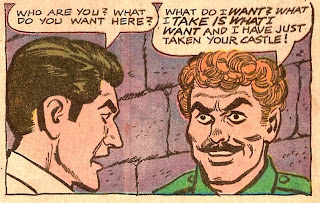
He's Eval, get it? Get it?Anyway, Dracula decides he must shut himself away from the world forever, lest it learn his terrible secret, that secret being that he is a total freaking moron. Alas, it is not to be, for Eastern European strongman Boris Eval trucks up to the castle with a few truckloads of nuclear missiles and sets up shop on Dracula's front lawn.

Eval, who looks like Josef Stalin in a Harpo wig, has an eval plan (get it?) to take over the world by starting a nuclear war between the superpowers.
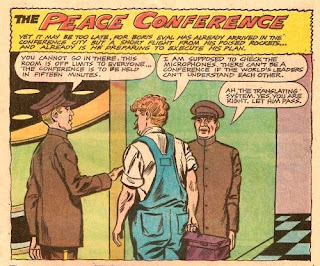
Master of DisguiseStep one: disguised as a common workman with an outrageous mustache and a Harpo wig, Eval plants bombs in an international peace conference. He plans to kill all the officials at the conference, then while the world is in chaos, launch his missiles into space, fooling the superpowers into thinking that each has launched a first strike on the other, triggering a nuclear holocaust. Then, Eval, who is tucked away safely in remote Transylvania, will emerge to claim the reins of power over what's left of the world.

Luckily, the conference is being held within easy bat-flight range of Castle Dracula, so Dracula is able to warn the conferees of the danger. Eval's plot fails.
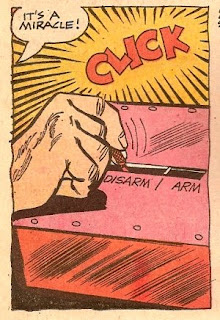
Wow, that's a handy gadgetHe still has his nuclear missiles, however, so Dracula next leads a horde of bats in an attack on the missiles. Panicked at the thought of the missiles toppling from the weight of the bats and exploding, Eval flees and wrecks his car. Luckily, his disarming device falls out of the wrecked vehicle, and with one flick of a conveniently labeled switch, Dracula saves the world.

Dracula then decides to use his powers for the good of humanity. He orders a ton of gym equipment delivered to his castle in ominous-looking wooden crates. There follows a quick training montage, in which we learn that T-shirts bulk you up.

Dracula in civilian garb:

98 lb weakling

Dracula in gym clothes, but still before training of any kind (check out those guns):

Welcome to the Gun Show

Dracula then goes to a nearby village, where he leaves an order with a tailor for a costume, then captures a couple of robbers with his newfound muscles, where this happens:
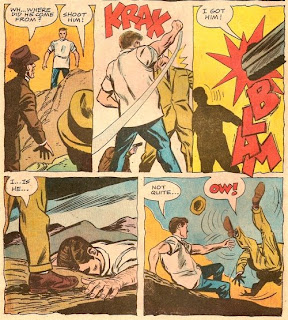


Did the bullet bounce off? Did the robber miss? Was Dracula wounded, but healed quickly? Or was he wounded and merely fighting through the pain? Who knows? Who cares?

So Dracula picks up his costume and returns home to find his castle in flames. The superstitious townspeople, terrified by all the suspicious deliveries and activity around the castle, have decided to put an end to the evil in their midst. Dracula is appalled at the fear and ignorance of his fellow men, and pledges to fight against evil, corruption and greed in an effort to make people really, really like him.

So ends Dracula's "collectors edition" origin story, at which point nine-year-old you says, "Wait a second! This is a Dracula story without a vampire! What a rip. I might as well sell this thing to some other idiot at the school rummage sale."

That idiot, of course, was me.

Wednesday, February 11, 2009

Big Audio Wednesday - Sleep No More

So I listened to a huge chunk of Escape and Suspense (one of which will be next week's Big Audio Wednesday) and decided to look for something more offbeat.

Which led me to Sleep No More.

Sleep No More was a different kind of suspense show. Instead of performing dramas with a stock cast and maybe a weekly guest star, Sleep No More was formatted around a man named Nelson Olmsted, who read and performed all the short story adaptations in the series. He was entirely a celebrity of his time, quite famous and successful in his day, virtually forgotten now.

For this week's feature, here's the November 21, 1956 episode of Sleep No More, an adaptation of the Nelson Bond short story, "Conqueror's Isle." Click the widget to listen.


"Conqueror's Isle," first published in 1946, had been adapted before. It was an episode of Escape in 1947, and was performed on television in 1953 as an episode of Tales of Tomorrow. I haven't seen the television version, but I think the Escape adaptation is much better than the Sleep No More.

So why am I presenting the Sleep No More version? Because this adaptation differs from the Escape one in one significant way (actually two, but the other isn't the reason I chose it).

You see (and I make no apologies for the spoiler here--the story is over 60 years old, and it's not that great to start with), "Conqueror's Isle" is about mankind faced with the threat of evolution, specifically with a race of advanced mutant supermen with abilities far beyond those of ordinary humans.

And in this adaptation, those mutant supermen refer to themselves specifically as Homo Superior. Now, I know that the term was first coined by Olaf Stapledon in the novel Odd John in 1935, but I wonder if Stan Lee and Jack Kirby, when they were creating X-Men in 1962, would have been more influenced by an almost thirty-year-old novel or by an episode of a popular radio show that aired a few years previous.

I'm not saying definitively that this show inspired the X-Men. I'm just saying that it's possible that it was an influence. At least, it's fun to listen to in that light.

Monday, February 09, 2009

On Pins and Needles

It was a low-key weekend. Went to see "Paul Blart: Mall Cop." It was fun enough. "Die Hard" is just about my favorite movie ever, so the simple fact that it was a "Die Hard" parody was enough to get me into the premise. But the movie spends an awful lot of time trying to convince you that Kevin James' loser character is actually a lovable loser, and then spends a long drunk sequence making you think that lovable loser is really just a creepy loser. It takes a long time to win back that lost goodwill. It's okay, but there weren't enough big laughs, and it needs to take too many big plot leaps to make you think this guy would have any freaking chance on Earth to stop the bad guys.

Spent much of the rest of the weekend listening to old radio shows--Suspense, Escape, and X Minus One mainly. I've got shows scheduled for the next three Big Audio Wednesdays.

I was mainly just trying not to panic about this week. I'm waiting on a very important phone call that my immediate future hinges on. I hoped it would come today, but it didn't. I'm keeping my fingers crossed for good news tomorrow.

Saturday, February 07, 2009

Out of the Vault - DNAgents


In 1983, as the direct market was first finding its feet, several independent publishers jumped into the market and started publishing new titles to compete with Marvel and DC. One of the first and most fondly remembered is Eclipse Comics' The DNAgents.

Created by Saturday morning animation veterans Mark Evanier and Will Meugniot, the DNAgents were five superpowered teenagers who had been genetically engineered in a lab by the Matrix Corporation, and were used as corporate troubleshooters/bodyguards. The five were Surge, who could shoot electricity; Tank, super-strong and super-tough; Rainbow, a telepath and illusionist who relayed orders from their bosses at Matrix and functioned as a leader; Amber, who created electromagnetic discs that she could use as force shields or weapons; and Sham, an insecure shapeshifter who could also fire any weapon made.

The series ran for about two years under its original title, then switched gears and became The New DNAgents for another 17 issues.

Thinking back, I had thought that I would write a big entry on the DNAgents, but couldn't remember much about them. Digging into the Vault, I discovered that I only have four issues. No wonder I couldn't remember them well. But why did I only buy four issues? Rereading the issues, I remembered.

They were bland.

I'm not sure what it was specifically. Meugniot's art was part of the problem. He has done storyboards on tons of shows I really liked, but his skills didn't translate well to the page. His layouts were often cramped and confusing, which resulted in stiff, unnatural figures.

For instance, the panel at right, featuring Surge fighting the hit-man Luger. There are two big figures performing four simultaneous actions (Surge drawing glass fragments out of his eyes while shooting lightning, Luger dodging the lightning while throwing a knife at Surge). The layout takes your eye in a nice circle and down to the next panel below, but the two figures are really crammed in there, with Luger in particular having to wrench into a painful pose.

At the same time, the writing was walking a strange line between reality and fantasy. The DNAgents tried to seem more realistic than Marvel and DC comics by using genetic engineering and corporate malfeasance to ground its setting. And the characters went through their share of angst, with Surge especially going through a dark phase as he attempted to avenge the death of his one true love in issue 3.

But the added "realism" just made the superhero aspects of the story that much harder to accept. In issue 10, Surge's and Tank's girlfriends react with horror when they discover that their boyfriends are artificially-created organisms with superpowers. It was supposed to be poignant or something, but all I could think of was, "Their names are Surge and Tank. You had to know something was up." (And if you are wondering about Surge's girlfriend in issue 10 when he's mourning the loss of his true love from issue 3, well, let's just say that consistent characterization wasn't a strong point, either).

Another problem was the tension between Evanier's Saturday morning instincts and the attempt to introduce more adult fare into the comic. Meugniot loved to draw cheesecake into the comic, such as the above shot of the DNAgents in their breeding tank, or this shot from issue 2 of Tank's soon-to-be-girlfriend (and later-to-be-ex-girlfriend) in a towel.

(And given what has happened in the comics market since, it's amazing to note just how controversial this was in 1983--the issues I have print several letters complaining about the semi-nudity in the book)

At the same time, you had villains like Mega-Man, a combination of Transformers and Voltron (a giant robot formed from the combination of five transforming trucks). The silliness destroyed the realism and undercut the mature aspects, while the darkness and adult overtones made it harder to accept the silliness.


Which isn't to say it was a bad book. It was just dull enough and inconsistent enough that I wasn't compelled to keep picking it up. The best thing to come out of it, in fact, was its spin-off, Crossfire (which will be discussed separately some other time).

If you're interested in seeing DNAgents for yourself, the early issues were collected into a trade paperback just last year.

Wednesday, February 04, 2009

Big Audio Wednesday - Escape

Today's Big Audio Wednesday offering is a "classic" Arthur Conan Doyle story titled "The Ring of Thoth." It was presented on Escape on Aug. 11, 1947, and stars Jack Webb in a surprising turn as a non-military non-cop. (ETA: This broadcast is available on the Escape HQ Encodes page-the audio quality on these episodes is awesome, much better than most of the old radio transcriptions on Internet Archive). Click on the widget to listen.


As stories go, it just proves why Conan Doyle's non-Sherlock Holmes work has been mostly forgotten. It's not very good, frankly.

But aside from the novelty of hearing Jack Webb play a millienia-old sorcerer, I'm posting it today because of its central premise: a man who suffered a tragedy so great that he was unable to move past it, even after centuries had passed.

Today is the tenth anniversary of the greatest tragedy in my life. It's something I don't talk about; very few people who didn't know me then even know about it. But as bad as it was (and it was very bad--something broke in me that day that will probably never be fixed), I moved past it and have been able to find life and a measure of happiness since.

And that's the way it should be, I think. It may be very romantic to think about a love so great that it completely destroys you when it's gone, but I think it says something more and better about the human spirit that people are strong enough to absorb that damage and move past it and keep living.

Tuesday, February 03, 2009

Tasty

Just for today, try Hero Go Home with a side of bacon.

Monday, February 02, 2009

Fine-the-frick-a-lee

Hero Go Home is now officially live. It will be updating every Monday, Wednesday and Friday.

As I've mentioned before, the first couple of weeks are going to look really rough, because I didn't have the technical steps in the process worked out. I've got the process pretty well mapped out now, so by the time you read the strips I worked on today (in five weeks time), technical problems will no longer be an excuse and any weaknesses in the strip will be purely my own.

Another caveat: this is not a gag a day strip. I'm adapting the plot of what would have been a Digger novel, so things may move slowly. In fact, the first month could be considered the pre-credits sequence in a movie. But stick with me, and I'll try to give you a ride worth taking.

Sunday, February 01, 2009

Consistency

I am officially unemployed. There's not much else I can say to that right now.

Still plugging away at the webcomic, trying to get that last strip finished to make a five-week buffer before the official launch tomorrow.

I've come a long way in the last month. I've gotten back into the swing of penciling and gotten a lot of practice with the graphics pad. My pencils have gotten a little tighter and my inks are getting cleaner. The big problem I have right now is consistency.

One hallmark of professional strips is their consistent look. Dilbert is poorly drawn, but Dilbert and Dogbert and Wally and the rest have a consistent look from panel to panel, crude as that look may be. In animation terms, that's known as being "on model."

And that's what I haven't yet achieved in Hero Go Home. You can recognize Digger by his costume and hairstyle, but I have been unable to draw a consistently recognizable face from panel to panel. I should be able to draw Digger in a dress (and that may be real concern at some point in the future) and have him be recognizable by his posture and facial features. But I haven't achieved that degree of consistency yet. That's something I need to aim for going forward.

Saturday, January 31, 2009

Out of the Vault - Faust


Faust #1In 1988, comics were going through a transition. Alan Moore had popularized a newer, darker approach to super-hero comics with his triple play of Miracleman, Swamp Thing and Watchmen.

Frank Miller had then applied that approach to Batman in Batman: The Dark Knight Returns, taking Batman back to his dark roots with a pulpy hard-edged storytelling style, following that success with the gritty Batman: Year One. In only a couple of years, the standard view of Batman had gone from a boringly noble knight of the night to a borderline psychopath, obsessed with cleaning the scum off the streets.

On the other side of the aisle, the most popular character for Marvel had become, astoundingly, Wolverine, an invincible little savage with super-sharp metal claws that extended from his hands, which he used on bad guys after flying into "berserker rages."

I say 'astoundingly' because Wolverine still appeared in books approved by the Comics Code Authority. Imagine if ABC had done a Saturday morning series in 1985 about Jack the Ripper. Think of the hoops they'd have to jump through to make sure his adventures passed Standards and Practices. Now imagine that they turned him into the hero of the show. That was Wolverine in the 80's.

So in 1988, out of Canada came Faust.

Issue #1 starts out with an editorial on the inside front cover saying:

And yes, this book is not for wussies. There is nothing I hate worse than listening to a person (think yuppie) talking about Faust - "Oh my, look at all the blood"...

Hey, we're not breaking your legs and trying to force feed you the book (although we should).


After that rather aggressive anti-sales pitch comes "A Letter From the Writer," David Quinn, describing the origins of the character in mock poetic terms and hilariously asserting that "If you slam through day and night in death, you might learn to appreciate the sanctity of life."

This happens to me, like, every dayHilariously, because nothing in the story that follows can be even loosely interpreted as sacred. The story opens with a shallow self-absorbed reporter encountering a street hooker who appears to be coaxing him into performing oral sex on her right there on the street corner (it should be noted that the story takes place in pre-Giuliani New York City, so this could very well have been a realistic portrayal).

After a few pages of sex/murder featuring characters who may or may not have anything to do with the story in later issues, we're introduced to Jade DeCamp, a psychologist who has recently quit her job at an institute for the criminally insane. One of her patients has recently died, and she suspects evil doings, so she has stolen his file (and a scalpel, for some reason).

However, it turns out that her patient, John Jaspers, is not dead. He's continuing his art therapy in a tenement room somewhere in the city, after which he dons a mask and cape and takes to the rooftops. Soon, he rescues De Camp and the reporter from a street gang, by slicing the thugs to ribbons with metal claws that extend from his gloves.

And here we see the true nature of the book. Faust is Batman gone full-bore psycho, without the Warner franchise hanging like a PC anchor around his neck. Faust is Wolverine in full berserker rage mode, without the Comics Code authority turning our faces away from the ugly truth of the character. Faust is the culmination of the trend started by Miracleman and Swamp Thing, but not limited by taste or talent.

I never read past the first issue. I was intrigued enough by Tim Vigil's art--detailed and dynamic, with definite traces of Eisner between the blood spatters--to buy the first one, but the story was a trudge through a sewer--an incoherent, pretentious sewer at that, full of adolescent, angsty poeticizing.

I can imagine that for a certain breed of fanboy, there was satisfaction to be found in seeing all those qualities that could only be implied in their favorite mainstream heroes brought out into the light. There must have been, because Faust, unlike some of the other books I've brought out of the Vault, lasted for a good long run and was even adapted into a movie. But for me, one issue of the Wolve-Bat was enough.

Thursday, January 29, 2009

It's Real

I have uploaded the first week's worth of strips to the site. They'll update automatically on the scheduled days (I can do the same thing here--I'm doing it now, in fact--but I should probably do it more, so I don't have to scramble on Wednesday nights to do a Big Audio update, or do a ton of scanning on Saturday mornings for the Vault).

So now I just sit back and wait until the strip launches itself (and by "sit back and wait," I mean "work frantically on week five's strips").

And no, I still don't know what I'm going to do for a day job. I've had two opportunities that looked good fall through, but I'm still employed through Friday. Freefall starts Saturday.

Wednesday, January 28, 2009

Big Audio Wednesday - Tom Corbett, Space Cadet

When I was a kid, one of the first books I remember reading was a book called Tom Corbett: A Trip to the Moon. It was originally published in 1953. I can't remember if the edition I read was a reprint, or if it had belonged to my older brother. After all, I was too young to even know who Tom Corbett was.

I think that book may have fueled my initial fascination with space. But it also left me thinking that the Tom Corbett series must have been incredibly juvenile. Imagine my surprise when I listen to the radio series now (as well is its contemporary, Space Patrol) and find stories that are indeed pitched toward kids, but at least nod toward real science. I mean, of course they take liberties with the physics--hard to imagine accurately portraying the silence of space in a radio program, after all--but on balance, they do a better job than most Saturday morning cartoons in our supposedly more enlightened age.

Supposedly, Tom Corbett, Space Cadet was heavily influenced by Heinlein's Space Cadet, so it shouldn't be surprising that it's got a harder edge than I expected. But that melodramatic organ has got to go.

So sit back and enjoy this presentation of the Tom Corbett two-parter, "Rocket Into Danger."

Tuesday, January 27, 2009

Snowed In

We finally got a decent-sized winter storm. I drove home from work last evening, bundled up and started working on the webcomic, then got a call from work. Had to go back to work at 10 p.m. and work all night.

The great thing about driving in treacherous conditions at 10 p.m. is that hardly anyone else is out on the road, so got to work safely. Drove home at 6:30 a.m., exhausted, put the car in the garage. Fell into bed and slept a while. Got up and spent the day listening to Webcomics Weekly podcasts and coloring pg. 5.

The tricky thing about the strip I'm doing, and I'm not sure I'll be able to pull it off, is that I'm trying to do a continuing story in three and four-panel increments. So I've got to on the one hand tell an overall story, while at the same time making each day's strip a sort-of self-contained bit in itself. I'm getting better with every page, but I'm still faking the funk when it comes time to draw the backgrounds. That's something I'm going to have to work on more when I get into the story proper.

Sunday, January 25, 2009

Trapped in the Vault

I'm sorry I missed my Out of the Vault update this week. Between trying to double my webcomic output (I'm not quite going to make it) and having to work overnight Saturday, I just didn't have the mental energy to switch gears to it. Out of the Vault will be back next week.

Friday, January 23, 2009

Robot No More

Bob May died last week. One is tempted to make a "Danger, Will Robinson" joke, because that was his best-known role, but Robot jokes felt stale long ago. And besides, May's career encompassed much more than just wiggling his arms inside a Robot suit. He was a comedian, an actor, a dancer, a stuntman. He was one of those guys who was literally born into the business, had it in his blood, and did whatever he needed to do to keep his hand in. It's cool that he was able to luck into a role that turned into a cultural icon, though.

Thursday, January 22, 2009

Impatient

I've been trying to put this thing together in a systematic way, applying the lessons of a lifetime studying film and comics and writing, and learning from the successes of people like Scott Kurtz and Howard Tayler. So I set a launch date far enough out to give me a five-week buffer of finished strips. That is, if I could maintain a schedule of at least a page a week. The long lead time was also meant to let me see if I could do that and put out an acceptable product.

So here I am, three pages into the project, and trying to double my output this week, because I decided to do a splash page (I'm approaching this with an eye toward a finished printed product, so even though I'm splitting the pages into strips, I'm laying them out a page at a time, which means that even though each strip will have a constant width, the the height of strips will vary depending on the layout I'm following for that page).

In addition to the increased workload, I opened a Project Wonderful account with an eye toward putting ads on the site (I've got holes in the site layout specifically for ads), but I can't put Project Wonderful ads on my webcomic blog until I've got 30 strips published, which means 10 weeks. And I'm determined not to solicit readers until I've got at least a month's worth of strips for them to read coming in.

So that means another week-and-a-half before I've got anything published at all, another month after that before I begin getting any kind of real traffic (if ever), another month or two after that before I can fill my ad holes, and who knows how many months after that before I can pay for a beer out of my income from the strip. And probably two years before I collect enough pages to do a printed collection. And I'm kind of anxious say, "To hell with the schedule and the buffer and being systematic. Let's just throw stuff out there right now."

In the meantime, I'm going to be unemployed in nine days.

So both my confidence and my motivation are taking a hit at the moment. But I am frantically inking pages 4 and 5 right now, and as a small preview, here's a look at a portion of page 4. I almost hate to ink over this, because I think it kinda looks cool with all the perspective lines.

And no, it's not upside down.

Wednesday, January 21, 2009

Big Audio Wednesday - Special Guest Suspense

Racing to get this update done before the scheduled outage this afternoon.

Today's Big Audio Wednesday features the stunning 1957 radio debut of a "bright new luminary in the Hollywood firmament who is presently being seen as Morgan Earp in 'Gunfight at OK Corral.'" It also boasts one of the silliest twists I've ever heard in an 'adult' radio drama and a misleading title.

So sit back and enjoy "Flesh Peddler" (which has nothing to do with porn or slavery), the August 4, 1957 episode of Suspense, starring evil Speedy Alka-Seltzer, Huckleberry Hound, and a young Earp who would later end up on the wrong side of the same gunfight.

Monday, January 19, 2009

2 Weeks and Counting

So all in all, it was a productive weekend. Had a meeting concerning what may turn out to be my new day job. Did some Vaulting and listened to a lot of old radio. Found my next Big Audio Wednesday, featuring an early appearance by a very familiar personality.

Colored the third week's worth of strips and finally solved my inking/lettering problems. The third week's strips look as good as I can make them right now, which is to say, any flaws therein (and there are many) are entirely due to my own limitations as an artist and not artifacts of the production process.

I started to despair late Sunday afternoon, because although I'd seemed well ahead of schedule early in the week, the coloring had seemed to expand to fill the remaining space, so by Sunday evening, I was racing to get done. But when I actually finished it and saw that the final result was pretty good, I was filled with enthusiasm and penciled all of page four right then.

I had been awaiting page four with some trepidation, because I was planning it as a splash page, meaning I was going to have to do some more extensive background work than I had done up to that time. As it turned out, the pencils look pretty darned good. Now I'm afraid to start inking them.

Meanwhile, since page four is a splash page, I'll need to move on to page five this week to complete week four's strips. I'm determined to have five weeks' worth of strips ready to go by the time I launch two weeks from tonight.

Saturday, January 17, 2009

Out of the Vault - The Griffin


Cover of The Griffin #1When I first began thinking about doing "Out of the Vault," I sat down and thought about what series I might like to revisit. And one of the first that leaped to mind was something called The Griffin.

The Griffin was a six-issue prestige format miniseries from DC, the same format they used for Frank Miller's Batman: The Dark Knight Returns and Alan Moore and Dave Gibbons's Watchmen. Written by Dan Vado with art by Norman Felchle and Mark McKenna, The Griffin told the story of Matt Williams, who returns to Earth 20 years after being abducted by aliens. Problem is, he's now an alien-enhanced super-soldier and a deserter, and the aliens are coming to get him back.

The Griffin was supposedly an expanded version of a comic Vado had published three issues of under his own label, Slave Labor Graphics. I was familiar with another Slave Labor title at the time (the late, lamented Hero Sandwich, which will be making its own trip out of the Vault someday, though for now it's still locked away for safekeeping), so I hoped for the same mix of action and humor when I bought the first issue of The Griffin.

I didn't get it.

The Griffin is an odd duck (so to speak). On one level, it's a superhero story, featuring people with mighty powers battling an alien invasion and each other.

I move that we dispense with the reading of the minutes and move directly to the ass-kickingOn another level, it's a space opera, with Earth facing off against an alien empire, and political factions battling for internal control as they order their forces into distant battle.

On another level, it's a straight drama about humans dealing with grief and loss and sacrifice. Matt Williams returns home twenty years after disappearing without a word, and is surprised to discover that a) everyone assumed he was dead, b) they have moved on with their lives in the meantime, and c) not everyone is jumping for joy at his return. So as he's spending 6 issues battling other super-beings and an alien invasion fleet, he's also trying to learn how to be less of a dork (with limited success). In the meantime, the supporting cast all face grief and loss in their various ways. There's a surprising amount of character development in what is ostensibly an action story.

And it should be no surprise that this development comes at the cost of the action. Unlike most action comics which try to include a major action sequence in each issue, The Griffin is arranged like a stand-up routine--set-up (issue 1), punch line (issue 2), set-up (issue 3), punch line (issue 4)... And much of the action takes place off camera, so that certain plot elements that seem as if they should be major set-pieces are resolved surprisingly quickly.

In fact, everything is resolved too quickly. The 6-issue format doesn't give the authors much time to linger on things, especially given all the elements crammed into the story.

So on the one hand, I really liked the attempt at adult drama, the huge scope of the story, the surprisingly appealing artwork of Felchle and McKenna, the awesome coloring job done by Steve Oliff and the Olyoptics crew. But I was also disappointed that the story never really seemed to hit that groove of awesomeness that was hinted at in early issues. Like Revenge of the Sith, it seemed to be in such a hurry to hit all its marks that it never seemed to settle down in the moment and really hit home. That's something for me to consider as I work on Hero Go Home.

Oh, and one other thing: although it was published in 1991, it is quite clearly a product of the 80's. The plot concerns alien abductions, an alien empire ruled by a corporate board of directors (echoing much of the cyberpunk fiction of the 80's), a shadow government infiltrating all levels of the United States (Ollie North is even called out by name at one point).

How Eighties is it?

This Eighties...

You don't want to know which elements of this outfit I used to wear in real life

Mohawk, torn T-shirt with punk slogan, spiky Mad Max shoulder pads and a Walkman. Yeah, baby. Keep feeling fascination.

Thursday, January 15, 2009

Inking

One of the things I've had to decide about the webcomic has been how often and how much to post. No two comics seem to post the same. PVP updates a single strip 5 days a week. Schlock Mercenary updates like a newspaper strip, with single strips six days a week, and a larger one on Sundays. Girl Genius updates full pages three days a week. No Need for Bushido and Atland update once a week.

For Hero Go Home, I made the decision to update single strips three days a week, Mon-Wed-Fri. This comes out to approximately a page a week, which is a schedule I think I can handle. This week, I seem to be ahead of schedule. The last two weeks, I penciled Tues-Wed, inked Thu-Fri, and colored Sat-Sun. This week, I finished inking last night (Wed),and I'm ready to scan, letter and start coloring tonight.

Inking has been a challenge, but I'm hoping that I've about solved it. The first week, my inking was totally random and haphazard, which I justified internally by telling myself I wasn't really working on a real strip, just testing a concept. The second week, I was more careful, but still sloppy.

The common problem I had both weeks was that I tried to ink according to the traditional model of putting down the thickest lines possible. With normal production practices, oversize artwork is shrunk down to its printed proportions through a photostatic process. Lines that are drawn too fine will simply disappear.

However, the computer scanning process I've been using tends to thicken up the lines, so I need to work counter-intuitively and draw the lines as thin as I can. At least, I'm hoping that inking with thinner lines will give me a better result when I'm done with this week's strips.

I'm also debating about what tools to use. I'm currently using Faber-Castell PITT artist pens, which supposedly use an archival quality ink. I see other technical pens recommended by manga artists, but I don't know if switching would give me any better results. When I first tried inking, I used the traditional crow-quill pen with India ink, but that scritchy sound of the nib scratching across paper put my teeth on edge, as bad as fingernails on a chalkboard, plus it was really slow and prone to blotches if you pressed the nib down too hard. But now I'm looking at on-line inking tutorials like this one and wondering if I should give the crow quill another shot.

I've also experimented with inking digitally in Inkscape with the graphics tablet, which could potentially give me the cleanest result, but I'll need more practice before I can do that with any chance of staying on schedule.

Meanwhile, I'm still trying to solve my lettering problem. The balloons and letters look great in Inkscape, but look awful when I output to .png and paste them into GIMP. But I learned that GIMP can also import the .svg files directly. Perfect, except that for some reason, GIMP uses a default font in the balloons and won't let me replace them. If I white out the letters and retype them in GIMP, they look a little better, but still not very good. Maybe if I made them bigger, but it's hard to tell what size to make them in Inkscape. Or if I typed in the text, then converted the letters into paths, but that seems like an awful lot of steps for what should be a straightforward process.

Wednesday, January 14, 2009

Big Audio Wednesday - The Big Supes/Batman Climax

In which Batman tracks 'em down and Superman catches 'em, finally. Once again, these recordings from 1945 depict early versions of Batman and Superman. Batman in particular is much different from his current portrayal--less obsessed, less capable, less ultra-ninja and more a regular guy with a cape and more guts than any normal guy should be allowed to possess.

(ETA: Robin gets a chance to shine, as well)

The Story So Far:

Lois Lane has been framed for the murder of a federal agent by Dr. Blythe's Confidence Gang. Clark Kent and Batman have figured out that the real murderess must be an almost exact double for Lois, and after searching through old records, have come across the name of Dorothy Zelinka. While Clark and Lois wait at the courthouse for the jury to hand down its verdict, Batman races out to track Miss Zelinka down.

Monday, January 12, 2009

Three Weeks to Go

So three weeks to go until the big debut. And frankly, I'm getting worried. Everything is going more smoothly this week compared to last--the penciling was faster (if not much better), the inking showed promise in places, the lettering and coloring are going more smoothly.

But the end result is disappointing. Not in the sense of, "I'm not as good as my favorite artist, so I quit," but in the way they translate to the final web image. When I transfer the word balloons from Inkscape (where they look awesome--Blambot makes great fonts for comic lettering) to GIMP for coloring, they come out dithered and fuzzy and hard to read. When I transfer the inked, scanned artwork to a new transparent layer in GIMP for coloring, it comes out jagged and fuzzy (and yes, GIMP is the common factor here, but I've used GIMP for years with better results, so I'm kinda' stumped at what the problem is). So I'm still experimenting to find the best way to a decent final product.

And in the meantime, the first couple weeks' worth of strips are going to sort of suck.

And while I know that lots of good webcomics sort of sucked when they first started (look at the first strips of Schlock Mercenary or No Need for Bushido, for instance, and compare them to the present), the competitions tougher now. You've got to be better coming out of the gate.

My one salvation is that I've been working on my storytelling skills for years, so while I'm flailing artistically, I hope the story feels reasonably solid from the first frames.

So mark your calendars: on Feb. 2, the first strip will go live and Hero Go Home will officially debut.

Although, seriously, you might wait until March to actually start reading it. By then, I hope to have worked out much of the initial suckiness.

Saturday, January 10, 2009

Out of the Vault - MythAdventures


MythAdventures #1I'm gonna' ride this Foglio train till it falls apart, apparently.

So when I did my post on D'Arc Tangent, I mentioned that the format was inspired by Elfquest, from WaRP Graphics. Well, not too long after D'Arc Tangent faded away, Foglio was back in another book in the same WaRP-style format. It was MythAdventures, published by (of course) WaRP Graphics.

MythAdventures started off as an adaptation of Another Fine Myth, by Robert Asprin. Foglio wrote and penciled the adaptation, which was inked by new talent Tim Sale (who would later come to prominence on both Batman and for his work onf the TV series Heroes) and lettered by M. Lucie Chin.

A fine pair of myth-fitsThe story concerns a young magician's apprentice named Skeeve, whose teacher is killed moments after summoning a fearsome demon. It turns out that the "demon" is actually a dimension-traveling magician named Aahz. Aahz (who has lost his magical powers in the summoning) takes on Skeeve as his apprentice, and together the two battle against the evil wizard who killed Skeeve's master in a plot to take over the dimensions.

The books are breezy fun, full of fast action, witty dialogue and truly awful puns. Foglio added a layer of cartoonish action in his adaptation. For instance, in this dialogue scene, Aahz pulls a Bugs Bunny-style costume change.

Tell you what I'm gonna' do

Some have taken issue with the liberties Foglio took with the story, but how boring would it have been to read a comic story that adapted everything word for word?

After 6 issues, MythAdventures changed format from magazine size to a regular-sized comic book. Foglio left the book after 8 issues, finishing the first novel adaptation. The art was then taken over by Jim Valentino. Valentino's art didn't have the same verve that Foglio's did, and the book faded away after four more issues. Years later, Valentino left his job at Marvel to become one of the founders of Image Comics, so he made out all right, although the rest of us suffered.

Okay, okay, I know what you're thinking. You're saying, "But Fraze, what I really want to know is, did Foglio hitchcock in this one?"

Clean-up on Aisle ThreeDid he ever. While the book is bursting with little in-jokes and cameos--including a Lawgiver Robot from Buck Godot, along with Buck himself, Godzilla and the elves from Elfquest (to name a few)--Phil and Dixie and little Growf the dragon are featured in a subplot that runs across two issues during a visit to the Bazaar at Deva.

Thursday, January 08, 2009

Lessons Learned So Far

The learning curve has been steep, but progress continues on the webcomic. I've done the first weeks' worth of strips, and while they're not very good, they show promise.

Meanwhile, I've got a logo made and I've spent a few hours playing around with CSS stylesheets trying to find a look I like. I'm getting close to being satisfied with that. After I've got the look and feel down, I'll start working on content. I'm penciling the second week's strips now.

Back to work.

Wednesday, January 07, 2009

Big Audio Wednesday - Damn, This Superman Story Is Long

Okay here are the next three chapters of the Superman/Batman team-up, "Dr. Blythe's Confidence Gang." I included three chapters rather than two because there were an odd number of chapters left, and if I didn't include the third here, there would be no Batman in the team-up this week.

The story so far: Lois Lane is a dead ringer for Dixie Lamarr, a member of Dr. Blythe's confidence gang. Dixie was seen killing a federal agent, so Dr. Blythe put an elaborate plan in motion to frame Lois. And right now, the plan is succeeding. Lois is under arrest for murder, as Clark Kent and Batman search for evidence to clear her (click the widgets for streaming play in browser or right-click to download).


Next week: the thrilling conclusion.

Sunday, January 04, 2009

Webcomic Progress Report

So things are starting to take shape now. I got a suspiciously awesome deal on webhosting space, so I now have a domain to use for the comic (and if the comic doesn't work out, I'll at least put up all the Digger stories so far and maybe serialize a novel or something). I bought a graphics pad for input, although it's hard getting used to. I've figured out what my first storyline is going to be (Digger's Big Con, the prequel to Hero Go Home that I was working on for a while), and I've spent several hours working on the first page.

Two big problems so far. First, I made a lot of notes on Digger's Big Con, but I stored them on a mind-mapping software site called maps.kayuda.com, which is no longer active. So all that work is lost, though most of it is in my head still. Second, I have been working for days on this thing and have so far finished three panels. That's it--three. And they're not even great panels (the third one is pretty good, though).

So that's discouraging. But on the other hand, much of the time spent is in learning how to do a bunch of stuff I've never done before, so I can only get better. And I am determined to have something up on the site come Feb. 1. I may not be ready to start the strip then, but I'll have something.

And between now and then, I'll probably give you some updates and teasers.

Stay tuned. Things are going to get a lot more interesting in the next few weeks (I hope).

Saturday, January 03, 2009

Out of the Vault - Dynamo Joe #8


Dynamo Joe #8Since I've been on the Foglio kick, and was planning to revisit Dynamo Joe sooner or later anyway, I decided to just go ahead and do it this week.

Dynamo Joe was a giant-robo adventure inspired mainly by the Mobile Suit Gundam series. In the far future, the human race is part of a confederation with the alien Tavitans and the Imperium, a spin-off of humanity who are all descended from a single immortal ancestor. They battle the Mellenares, a race of telepathic alien microorganisms with a hive mind, who can link together to form monstrous creatures.

Joe's adventures, plotted and drawn by Doug Rice and scripted by John Ostrander, first appeared as a back-up feature in the series Mars by Mark Wheatley and Marc Hempel. The back-up was apparently popular enough that Joe was brought back as a feature in the First Adventures anthology series before getting his own four-issue limited series in 1986.

The next year, Joe became a regular series with issue 5 (continuing the numbering from the limited series). The one major change--Ostrander was no longer scripting the book. Phil Foglio was (Rice was credited with "Special Thanks" in one of Foglio's Buck Godot stories before he started writing Joe, so there was apparently a history there).

Taken as a whole, the series is pretty good space opera. The aliens are formidable. The stories range from small encounters to huge battles. The extended cast works pretty well together. It was a competent book all around, but it never jumped the spark gap from "This is fun," to "I gotta' have this book and tell all my friends about it!"

In issue 8, though, something unusual happened. Phil Foglio did some guest art. Here's the story.

Up in the air, Junior BirdmanPomru, Joe's Tavitan co-pilot, has been making some highly unauthorized changes to Joe, including an experimental "absolute zero super-cooled computer" (don't ask me how a computer can process data at absolute zero, m'kay? The tech is all standard manga-magic). He goes out for a test flight, but something goes wrong. There's an explosion that opens a hole in Joe's hull, allowing a cloud of Mellenares inside.

Once inside the Mellenares read Pomru's thoughts to determine what form they should take. As Pomru is thinking, "I'm my own worst enemy" at the time, the Mellenares form a green gremlin whose shape mimics Pomru's. And the battle is on.

Gotcha, ya varmint!

Let's try that again, shall we?

That's Foglio drawing the alien, finally getting to indulge in a little of his own cartoony style in an issue dedicated to Bob Clampett. In the end, after a series of slapstick encounters straight out of old cartoons, Pomru manages to defeat his telepathic enemy and succeeds in accomplishing what no one in the entire war has managed to do--take an enemy prisoner.

Ironically, although Joe's increasing popularity took him from back-up feature to anthology feature to limited series to regular series, he didn't last very long as a monthly book. The series was canceled after 15 issues (and as I discovered on New Year's Day, my run ends at issue 14--AAARRRGGGHHHH!!!). Part of it may have been due to Rice's difficulty in meeting a monthly schedule; Joe ran a back-up feature for several issues, cutting the lead story to 16 pages, and still needed Ben Dunn to do fill-in pencils for a couple of issues.

But for those of us who'd caught the anime bug and couldn't get our fill of the real thing (since anime and manga were still slow in coming here back in those days--kids today don't know how good they have it, consarn it!), Dynamo Joe was a fun jolt of giant robot action.

And now I've got to hunt through some back-issue bins for #15.

Thursday, January 01, 2009

Happy New Year

Went to a party with friends last night. Small group, but lots of fun. Slept late today, did some Vaulting (more Foglio coming Saturday), cooked up some sausage and onions and listened to some old radio (the Fat Man--he weighed 247 whole pounds, about the same as an average NFL player in 2006 and around 70 pounds lighter than an average offensive lineman).

I'm still working on the webcomic idea. It seems relatively simple on the surface, but in order to do it right, there's a whole range of things that have to be taken into consideration: not just the plethora of things that concern any piece of writing--plot, character, pacing, structure, dialogue--but also artistic considerations--character design, graphic design, logo design, typography, inking, color--and determining what compromises have to made in each in order to establish an efficient workflow that allows you to meet deadlines. In addition, there's website hosting and design and how to monetize it--donation box, advertising, merchandising, subscriptions?

Part of me wants to take time to work all this out before deciding to quit. Another part wants to jump in, get some feedback, spend the money to set up the site and see if it works. If I make money, fine, If I don't, well, it's tuition paid toward learning how to make things better next time.